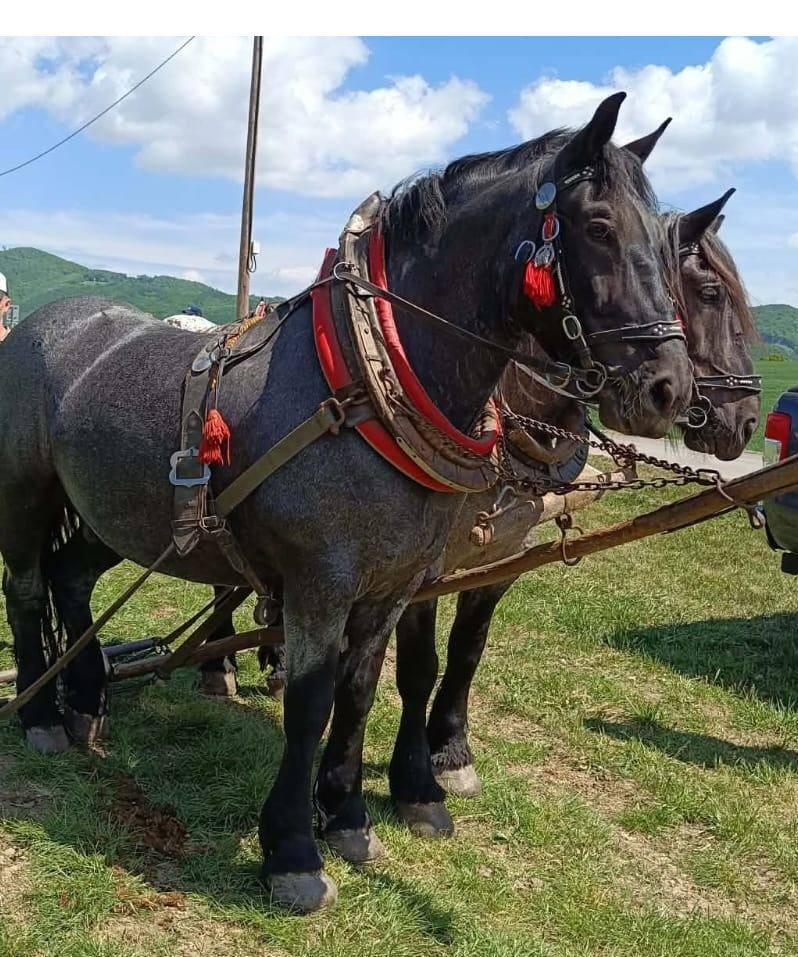
Story
Steiger is a draught horse who worked hard in the forest all his life. At work a log struck his hind leg and injured him. His owner saw that the treatment would be demanding, and he also knew that after years of hard labour in the hills Steiger's legs were already weak.
Steiger is nine years old. For a draught horse that is the best age: he should still have a good part of his life ahead of him. And yet he was on the verge of ending up at the slaughterhouse. That is all it takes for a working horse to become unwanted: one leg that stops working.
And this is where Steiger's owner made a decision we respect. Instead of Steiger ending up at the slaughterhouse, he decided to give him to our association, so that he could have a well-earned retirement with us, in the herd, on the pastures. We know the owner, and he knows us and what we do. That too tipped the balance in favour of Steiger's new life.
Now Steiger is with us. Ahead of him are treatment for his leg, peace and time. And after that just the herd, grass and freedom: what he deserves after a whole life of work.
How Steiger is doing
We write here as it goes, from the first day.
Steiger arrived at our farm today. The first thing we did was take the shoe off the problem leg : the one he couldn't put weight on. We contacted our vet straight away and arranged an X-ray.
That same day we rushed to her for painkillers. We had noticed, and the owner confirmed it, that pus had come out of Steiger's hind leg : the same leg he couldn't put weight on. And we also noticed how fast he was breathing. A horse that breathes like that is in pain. That is another reason we dealt with it straight away.
Our vet prescribed phenylbutazone, but deliberately not in a strong dose. Not so that he would feel nothing and put full weight on the leg, but just enough for him to dare to step on it and push the pus out by moving. It is a difference that is easy to overlook: here the painkiller was not there to cover the pain, but so the leg could start working.
We put him straight where his hooves won't suffer: the stable has a soft rubber floor and the outdoor paddock has sand. Stone, concrete or hardened earth would only break up his damaged horn further. A soft surface spares it and still lets him walk as much as he wants, and movement is exactly what a hoof needs to get blood flowing and grow.
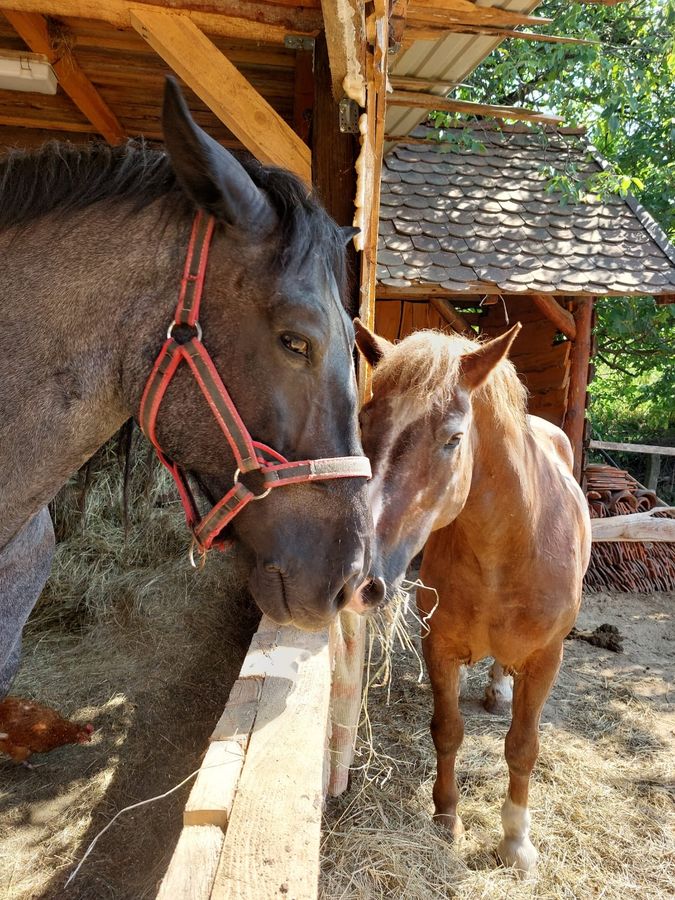
The first days in the shelter. Next to him Zuza, the one who will become his friend.
For the first three days we soaked his leg in a solution of Epsom salt. The medicine worked quickly: within twenty-four hours his breathing calmed down and he began to put more weight on the leg. By the second or third day the pus had properly come out.
After a few days it was the turn of the other hind hoof. We take his shoes off gradually, not all at once. A horse that has walked in iron for years has legs set to the shoe, and if we took all four off in one day, something we didn't expect might flare up at once and he wouldn't be able to walk at all. Better slowly, so he can cope.
He coped well. And taking the shoe off showed clearly what the shoes had done to the horn.
Why do we take his shoes off at all? A shoe holds the hoof in one shape, restricts its natural movement, and the nails go through the hoof wall. For a horse that will walk on pasture for the rest of his life instead of hauling timber, there is simply no need. A bare hoof can wear down and renew itself, if it gets movement, varied ground and time.
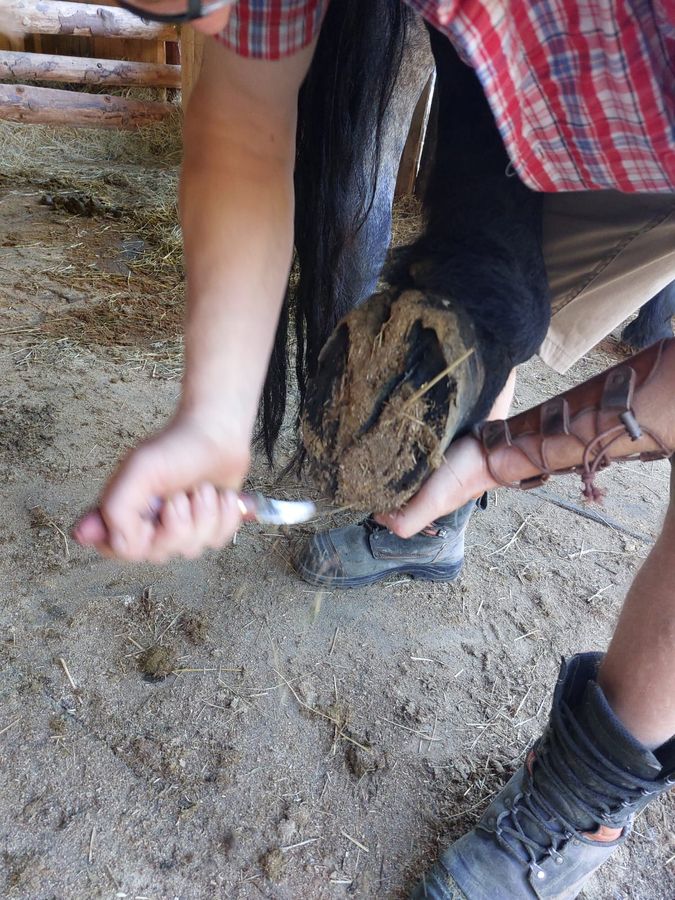
The other hind hoof right after the shoe came off. Sand from the paddock underfoot.
That day we were out on the meadow together for the first time. He and Zuza are already friends: a nine-year-old gelding who has done his share of work, and an old mare who has been through plenty too.
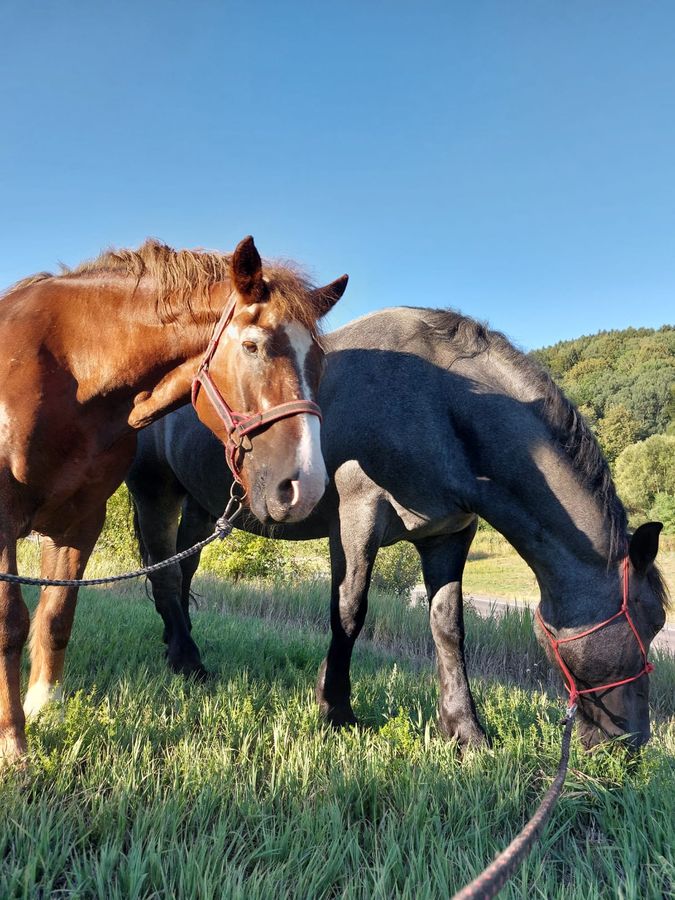
Steiger and Zuza on the meadow.
And that same day we also took off his front shoes. You could clearly see how hard walking was for him; the next day it was already better.
It also has to do with the fact that a shoe restricts blood flow in the hoof. A hoof is not just a hard case: with every step it spreads and compresses slightly, and this movement pumps blood by itself. The shoe holds it back from that movement. When a horse's shoes come off, the hoof starts working again, and suddenly he feels it. Including the unpleasant things he hadn't felt until then.
The horn on the front hooves is also in a catastrophic state. But a horse can recover from this nicely; it just takes time. It takes about a year for completely new horn to grow. It grows from the coronet downwards and can't be hurried; you can only create the conditions and wait.
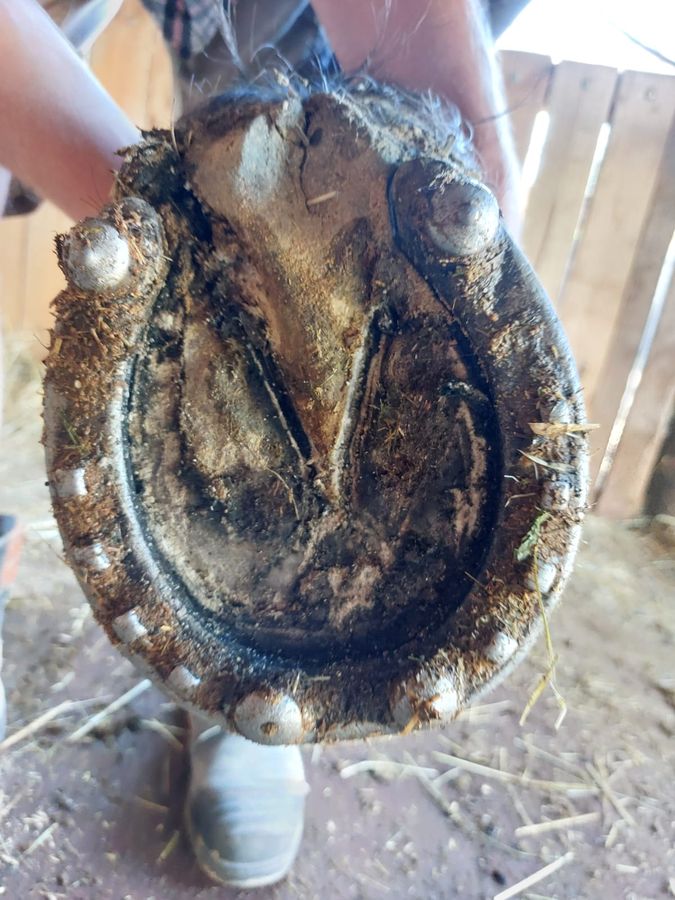
A front hoof still in its shoe: you can see the nails and the state of the horn around them.
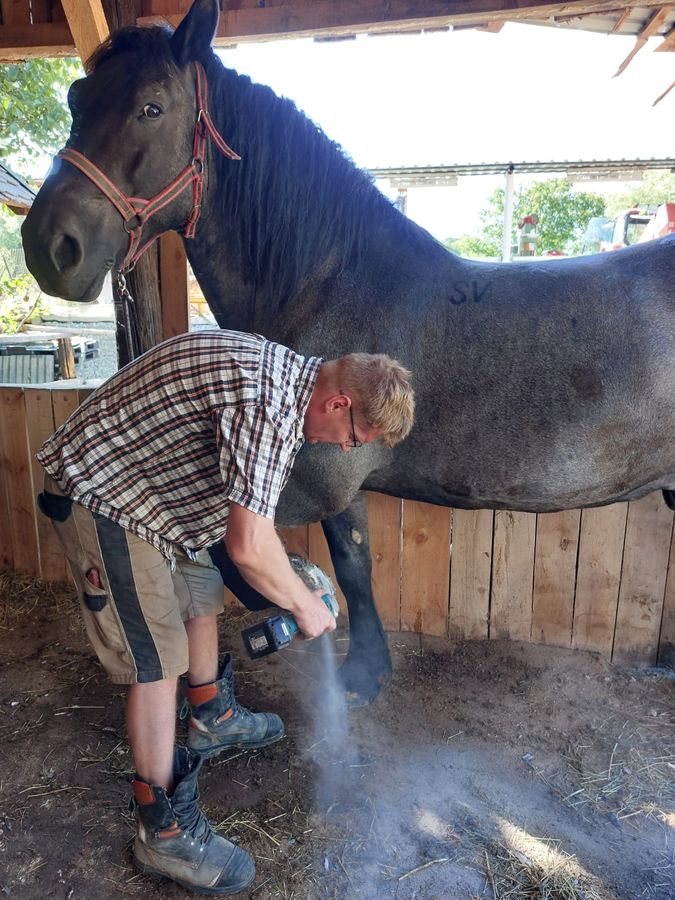
Trimming after the shoe came off.
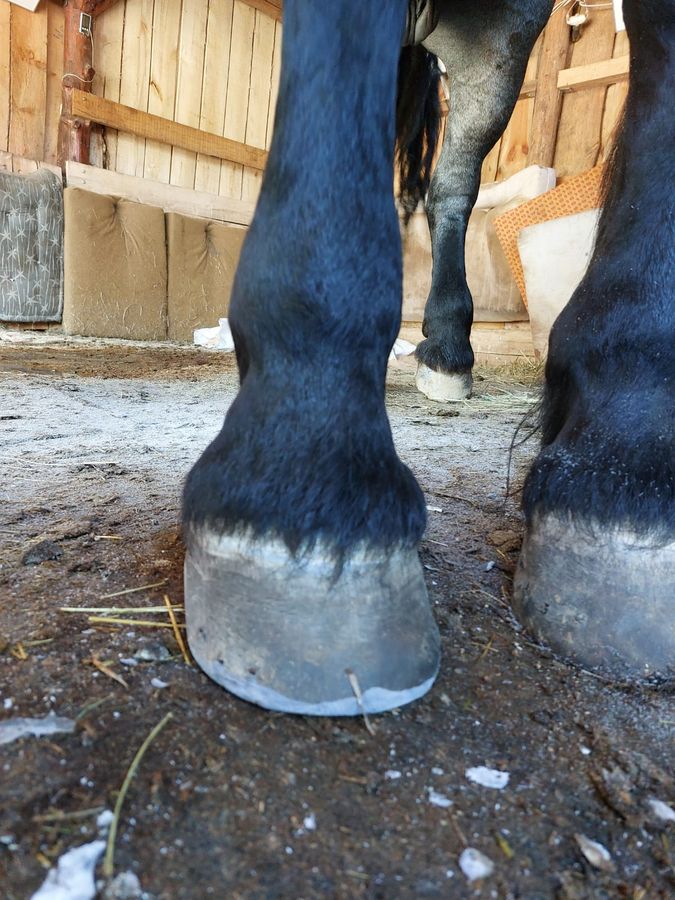
Bare hooves: from here they can only grow.
Since we took Steiger's front shoes off, he had been walking terribly tenderly; you could see it in his front legs at every step. After a few days he began to walk it off a little.
So we tried, very slowly, to move on to the pasture. For now only to the garden, so that he and Zuza could graze at least a little.
Part of the way there is on concrete, and it is on concrete that you can see the tenderness of his hooves again. But he made it. And in the garden, on soft ground, it was already fine.
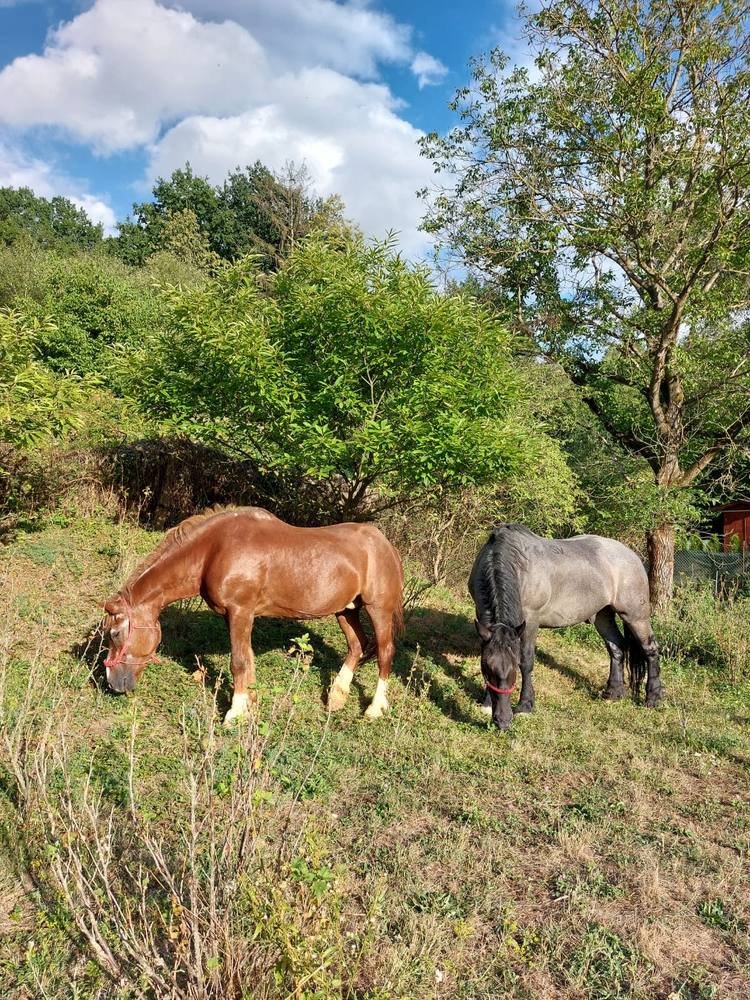
In the garden. On soft ground he walks well already.
And along the way Steiger also acts a bit as a guide horse for Zuza: Zuza doesn't see very well any more.
Yesterday I was playing with Steiger. I had my head leaning against his, and he was scratching my arm with his lips. But when I put my hand beside his head, on his cheek, he pulls a face a little and wants to bite me. He knows he mustn't; he only makes a hint of it. He is testing. He wants to play.
So we play. He lights up and doesn't know where the limit is. Or perhaps he does know it: he doesn't bite me.
And I can see it in his eyes. When we play a little or when I stroke him, you can see he is a bit confused. That he doesn't know. Doesn't know how or what.
I try to understand why he does it. Yes, horse people will explain it to me: he is testing dominance, testing where to place me. And yes, I don't give him clear signals either: once I put him in his place, another time I play with him. And at one moment, when he overdoes it, I feel fear. And he can read that language of my body. Straight afterwards I put him in his place again and show him dominance. He goes off a little startled, but he keeps looking at me and watching how I will behave. I walk around and ignore him, glancing now and then to see whether he is watching. After a while I go to him and stroke him.
We noticed this behaviour some time ago. When mucking out he gives Milka a hard time, but we know he wants to play. It always seemed more like play to us than showing dominance.
And this morning, when I woke up, it dawned on me.
They put him to work very young. At the time when he should have been playing. When he should have been a child. When he should have had a friend beside him. That is when they pulled him away and put him in harness.
And for work like that a young horse really isn't ready. We knew it before, from working with horses, but it was our vet who helped us put it in professional terms. She explained it to us like this:
A horse matures slowly. Its body keeps growing until roughly its fifth or sixth year, and the skeleton closes gradually, the spine last of all. In draught breeds it takes even longer than in smaller horses. A two-year-old draught horse already looks big and strong, but looking finished and being finished are not the same thing.
And yet they are put in harness early. Very often. It is common practice and nobody finds it strange.
And now he is showing us that he wants to play. That he wants to experience what was taken from him. And that is why those confused eyes: he never had anywhere to learn it.
For now he and Zuza are in the arrival enclosure. But we will give it to him when we let him into the herd. We have younger and healthy horses there too; he will have someone to play with. And the herd will both let him run wild and put him in his place, better than I can. Because you can clearly see that he is bored here.
And all of this was also his problem in his working life. He was terribly lively and didn't suit many horsemen; they said he was a horse only fit for the harrow. Even his owner, although he liked him and knew how to work with him, had his hands full with him: he had to hold him more and be on guard. Because Steiger is, and always has been, a lively horse who wanted to work. They just never let him be a child.
Today we grazed Steiger and Zuza on a piece of pasture that we are adding to the arrival paddock. For Steiger the most important thing about it is space. In the enclosure where he stood until now there simply wasn't enough room for him, and you could see it on him.
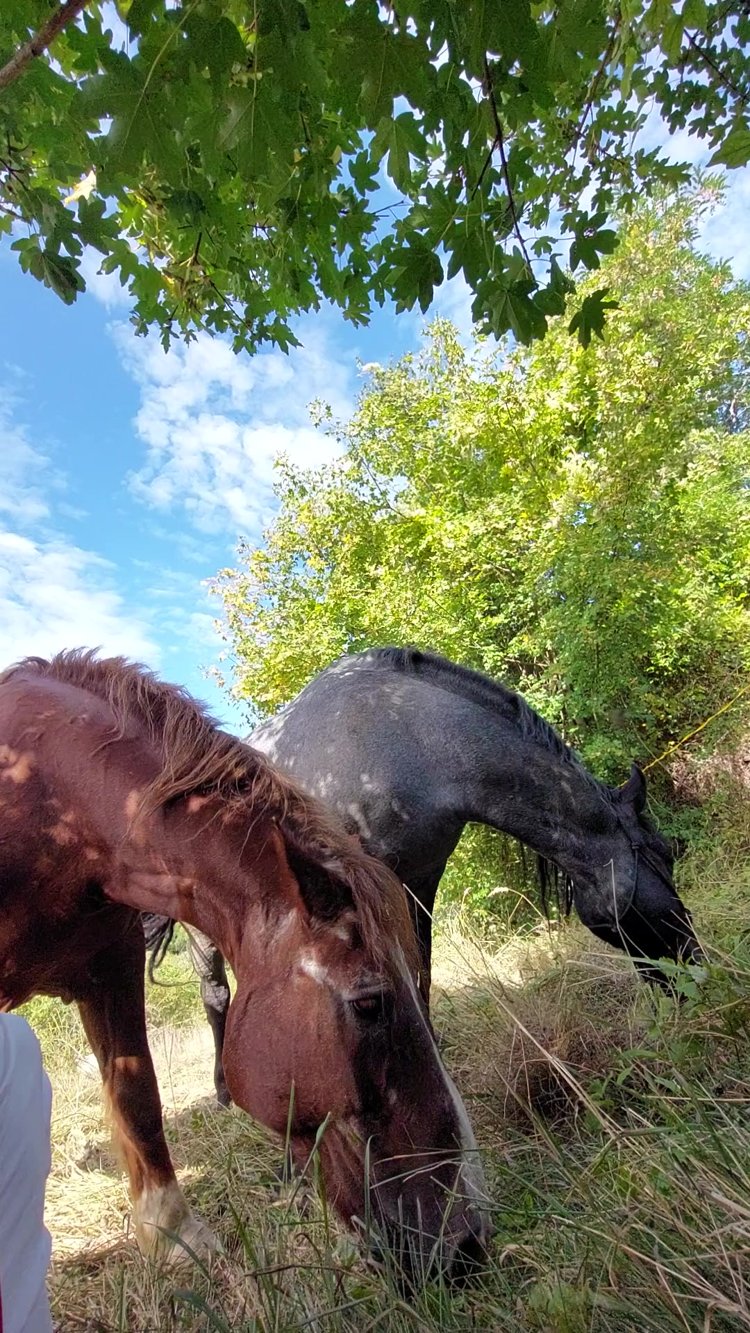
Steiger at the back, Zuza in front of him. Both of them just grass and nothing else.
And he grazed calmly. No testing, no nipping, no play. He stood in one place for a long time, nibbling the grass all around, then moved a few steps further.
Our neighbours have also let us graze a piece of that pasture. We will put up a paddock fence there so that Steiger and Zuza can go out on their own. It isn't the herd yet; that will come when he is healthy. But it is more room and more for the mind to do than a bare enclosure.
A few days ago Steiger started limping on his left front leg. Not a little. So badly that he could not put it down at all.
We knew at once that something was wrong, and the likeliest explanation was an abscess. We know a good deal about his feet already: we pulled his shoes, and every trim still shows the raw bruising the shoes left behind. Something like this was to be expected. A hoof that spent years in iron simply goes on healing for years after the shoes have come off.
I also checked the foot with hoof testers. They showed severe pain across the whole inner half of the hoof. I could not pin it down any closer than that.
And that is where what we know stopped being enough. We called our vet straight away. Both because the horse was in pain and one hoof had got worse, and because she has an X-ray and the foot could be looked at properly there and then. With an abscess that pays off. The sooner it is found, the less of the hoof has to come off.
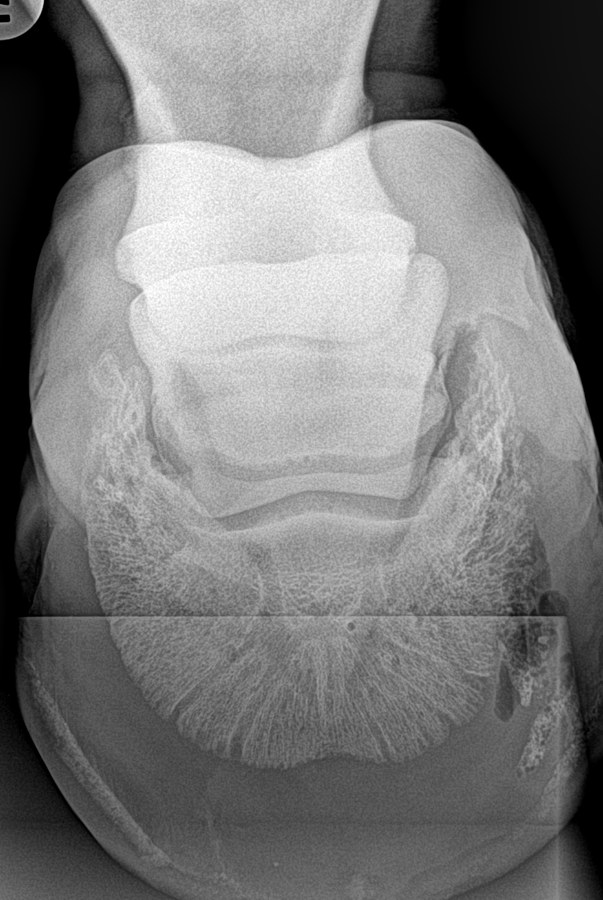
X-ray of the left front hoof, 1 October 2026. Our vet took it here at the farm. We have mirrored it so that the sides match the photograph of the hoof below.
The X-ray confirmed the abscess and found it exactly. And that was the valuable part. Not that we saw it. But that we knew where it was.
An abscess has to be opened so the pus has a way out. If I had been searching blind, I could have pared away a great deal. And that from horn which is weak as it is, and which may take a year yet to heal and grow down. This way we opened it in exactly the right place, and only a little of the hoof had to come off.
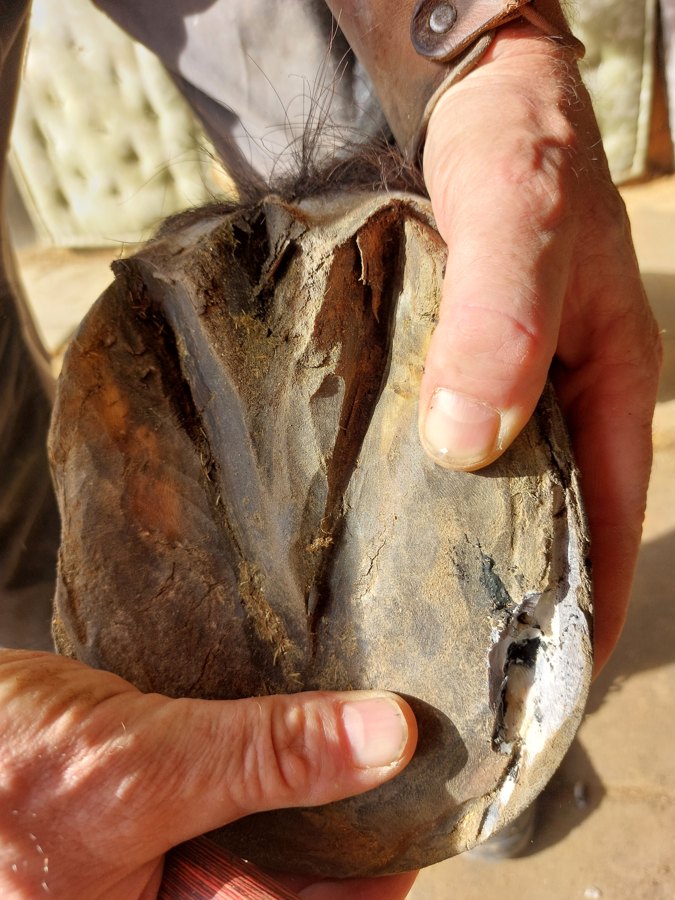
The underside of the hoof after the abscess was opened. The dark patch on the right is where the pus came out.
The abscess drained. Steiger was given painkillers as well. We cleaned the wound, flushed it and tidied the horn around it a little, so that no dirt gets pressed into the hole. We packed it with gauze and bandaged the foot. But not so that it was sealed. The pus drains into the gauze, so at every change of dressing we can see what is going on in there. The dressing is there to keep the dirt of the paddock out and at the same time let the pus drain, so that the hoof cleans itself, naturally. Sealing it is exactly the mistake that brings an abscess back.
The bucket is part of the aftercare too. We soak the foot in Epsom salt. The water softens it, the salt disinfects the wound and helps draw the abscess further out. It is not a one-off; we do it again and again while the wound is still cleaning itself.
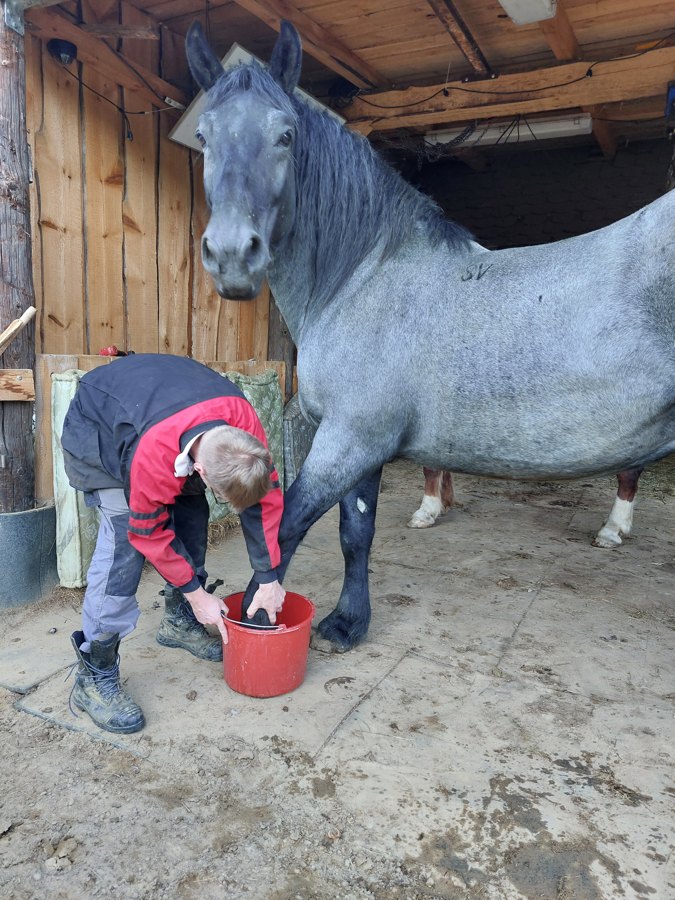
The foot in a bucket of Epsom salts.
The next day Steiger was visibly out of any real pain. And not only that. He is brighter too. He plays with me again, tosses his head, follows me about. He is more content.
Because when it hurt him, you could see plainly how low it had brought him. He stopped being himself…
The X-ray and the treatment were done by our vet, MVDr. Martina Jurčenková, CERP, VET & FIT.
A note on hooves
Going barefoot is no miracle cure and opinions on it differ among the experts. On a working horse on hard ground a shoe has its place. We are talking about a horse in retirement, with years of pasture ahead of him.
Anyone who wants to learn more about hooves should turn to the specialist literature; plenty has been published. You will find more than one opinion in it, and all of them are worth reading. We didn't take our approach from a single book, but from reading, from experience and from what we saw on our own horses, and always in agreement with our vet.
Thanks that go further
Steiger's story is not only about a horse. It is also about people who did the right thing, and whom we want to recognise and support for it. You can find their story and the collection to support them on a separate page.
Photo gallery: Steiger
Photos of Steiger since he came to us. Added as we go.
Virtual adoption
Steiger is after an injury and with his horn broken down by years in shoes. In October 2026 an abscess, which we had to X-ray and open. He has about another year of treatment ahead of him before new horn grows down. In that time there will be more dressings, more trims and more check-ups. A contribution for Steiger goes exactly to this. And to the hay he eats like any draught horse. Scan the QR code with your banking app, or use the account details below.
Bank transfer (SEPA)
Account holder: RIO o.z.
IBAN: SK97 8330 0000 0027 0350 7560
BIC/SWIFT: FIOZSKBAXXX
Payment reference: Steiger
Our account is transparent, every payment is public here. Before you confirm, please check that the recipient is RIO o.z. and the IBAN ends in 7560.
What we need right now →
A light aluminium shovel for mucking out, a corrugated pipe for a reservoir, LDPE hoses for a water supply, concrete utility poles. Maybe you know where to find them.
Thank you →
Everyone without whom it wouldn't work: those who come to help and those who support us professionally.