Every horse here has its own page and its own story. But a horse on its own is not the whole horse. What it is really like only shows when it stands among the others.
Our whole idea of how a horse should live can be said in one sentence: let it live as naturally as possible. And the most natural thing for a horse is a herd. Not a stable box, not a paddock for one, not friendship with a human instead of friendship with a horse.
We started this page because the things that happen between horses don't belong to any single story. They are our observations. We write them down as we see them and don't pass them off as science.
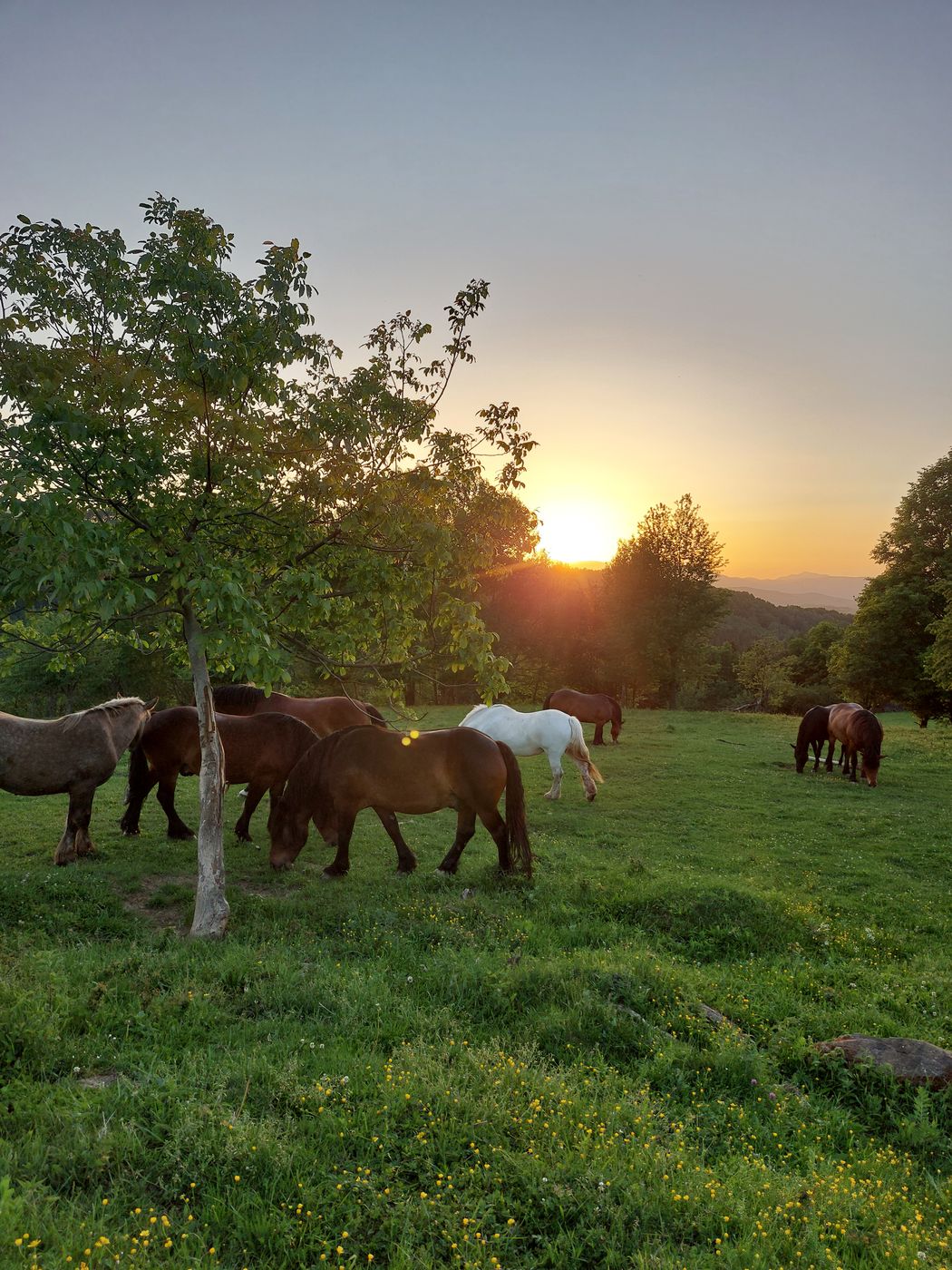
The story of the herd
Notes from the pasture. They are added as we go, according to what we see.
A night on the new meadow
I went out at night for a walk to the herd. I found them on the newly fenced meadow; it was just before midnight. Up there on the top there is a nice flat stretch.
The whole herd was having its rest. One after another they all lay down and dozed, some even snored. I lay down next to Maja, a little way from her so as not to disturb her, and dozed with them for a while.
I think only one horse was standing and keeping watch.
I often go out to them at night, watch them and lie down with them too. But I had never seen almost all of them lying down at once. There were always guards standing around the ones lying down, facing in every direction. And this time almost the whole herd lay there snoring, all except one.
So the new meadow will probably be fine. They seem to feel good there.
The herd is still waiting for its queen
It is more than a year since the herd lost its lead mare. It was Lucinka. She came to the farm first, and over time the herd grew around her. Luca was dominant by nature, so everyone new had to submit to her. She always knew how to explain it to them.
Today the herd is still split into two groups. They do move together, but sometimes it is Bela who takes the lead and they follow Bela, sometimes it is Najka who takes the lead and they follow Najka. Sometimes they split up and then call out to each other and look for each other until they get back together.
Najka was never that dominant; she used to be at the back and rather withdrawn. But she is the oldest, and now and then the herd follows her.
And when Najka lags behind somewhere, Orík, her son, has lately always been by her side. He guards her and watches over her like a model son. It wasn't always so. When he was going through his teenage years, he chased Najka around too and took liberties. Now it is as if he has grown wise.
It still seems to us that the herd is only waiting for its new lead mare. That it is still waiting for its queen.
When I sit down among them, they stand guard over me
It was a sunny day, so in the afternoon we let the work go for a while and went out to the meadow to take it easy near the herd. We have an old log bench there, falling apart by now. I often lie on it and there is always a horse who comes over — to check on me or to pester me.
These past few days I have found more time for them and given them a proper scratch. They are used to being scratched and they like it. And after that, naturally, they want that attention all the time.
Along came Bela. We had recently trimmed her feet and re-shod that damaged one. She leaned down to me and gave me a bit of a scratch herself. Maybe she wanted me to scratch her, who knows. But you can see she has been more affectionate these past few days. Perhaps that foot hurts her less.
So there I sit on the bench and Bela takes her ease above me and dozes. She is simply standing guard over me.
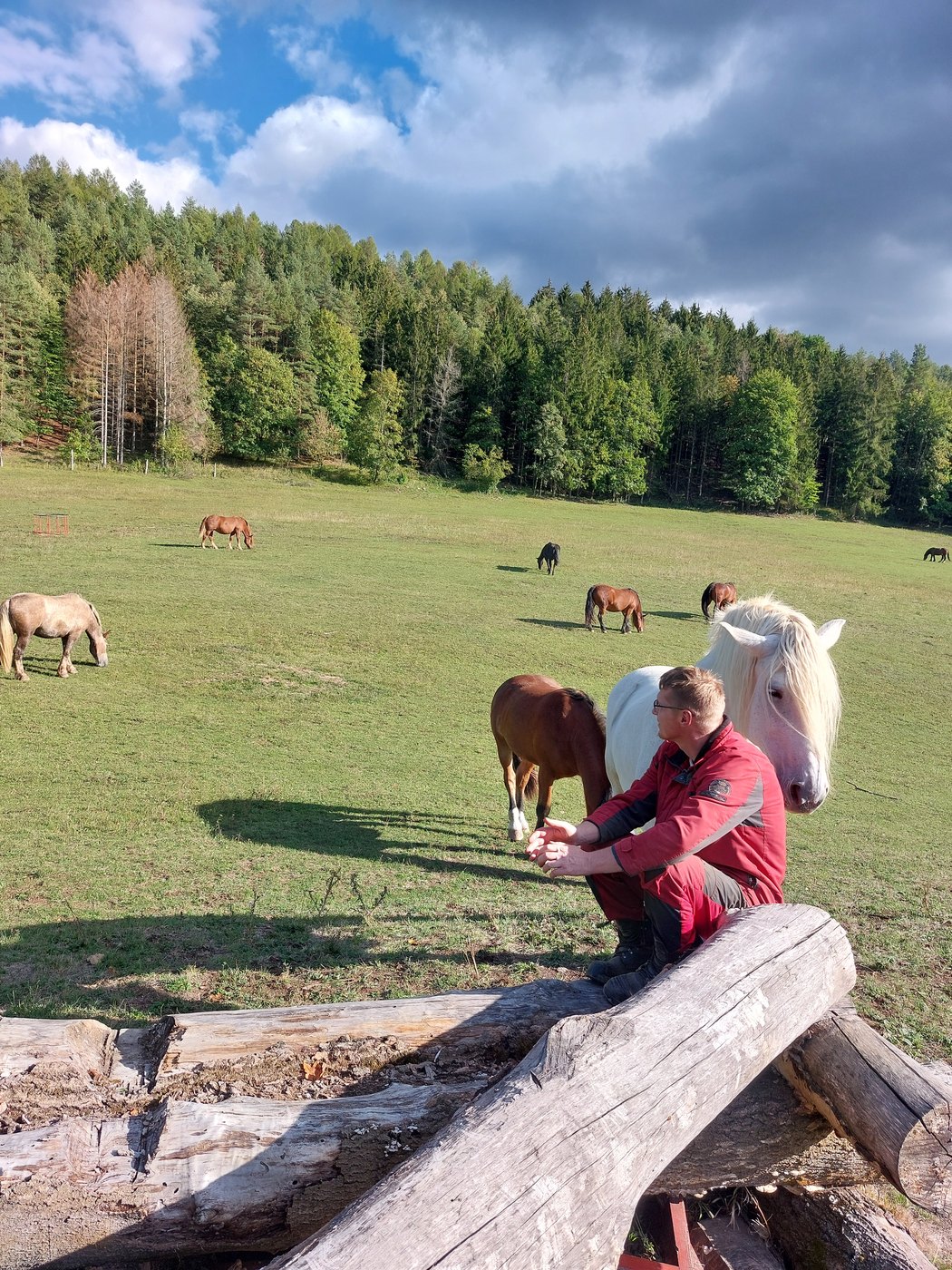
The older horses always do this. If I crouch down anywhere or sit under a tree, one of them comes over and stands above me. Exactly the way mares do when their foal is lying down asleep — they stand over it and guard it.
So they take me for a member of the herd who is on the ground, resting. And that one gets guarded.
But when one of the youngsters turns up — and after a while along came Čilko — then I have to watch myself. They do not guard me. They want scratching or they want to lark about, so they give me a shove with the head straight away, sometimes with a foot. And from a horse that is a kick to the head in an instant. They mean no harm, they want attention. But with the young ones I am careful when I am down on the ground.
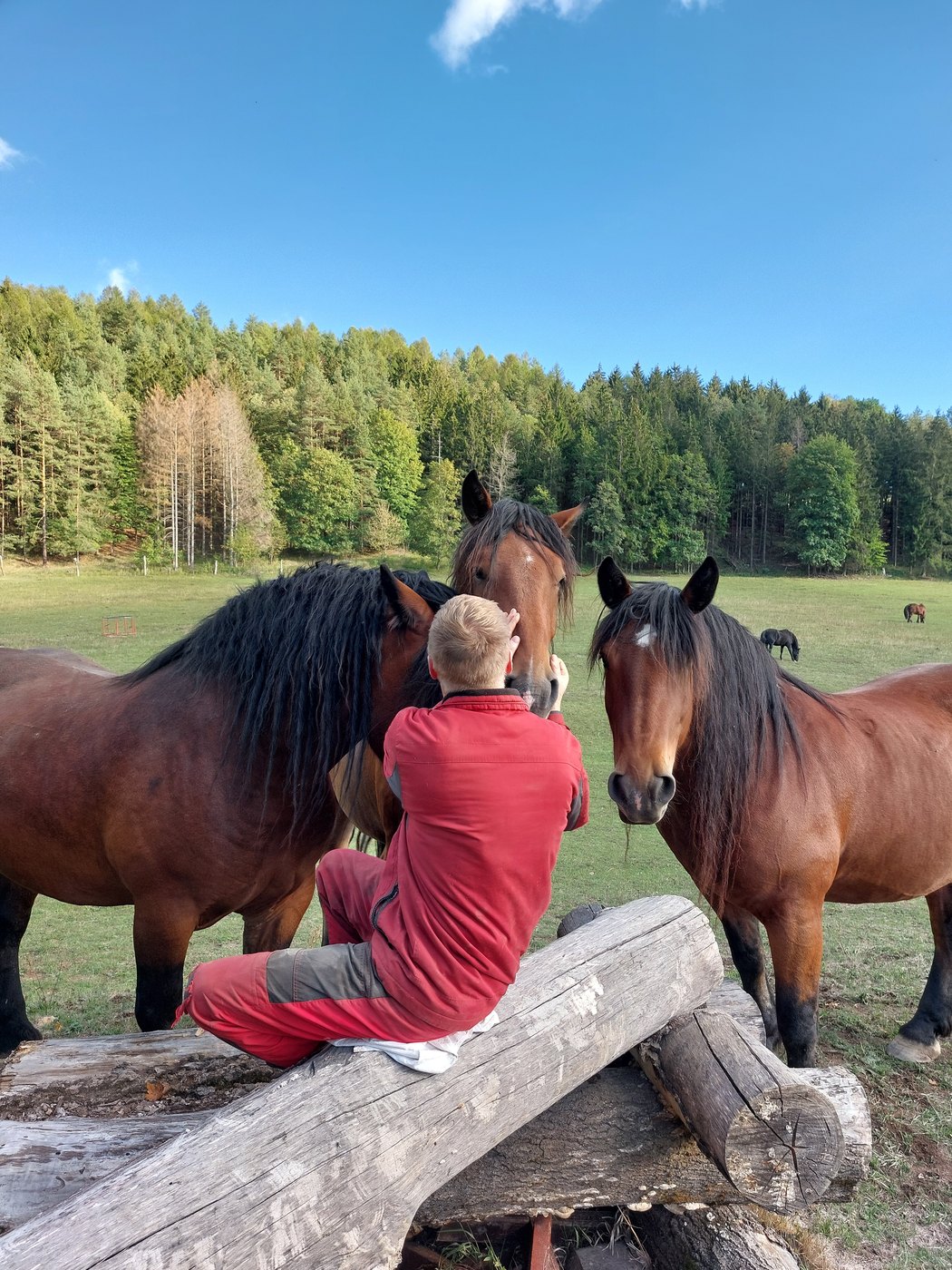
We are their friends and members of the herd. If a stranger came, every one of them would be on alert. They simply know their own.
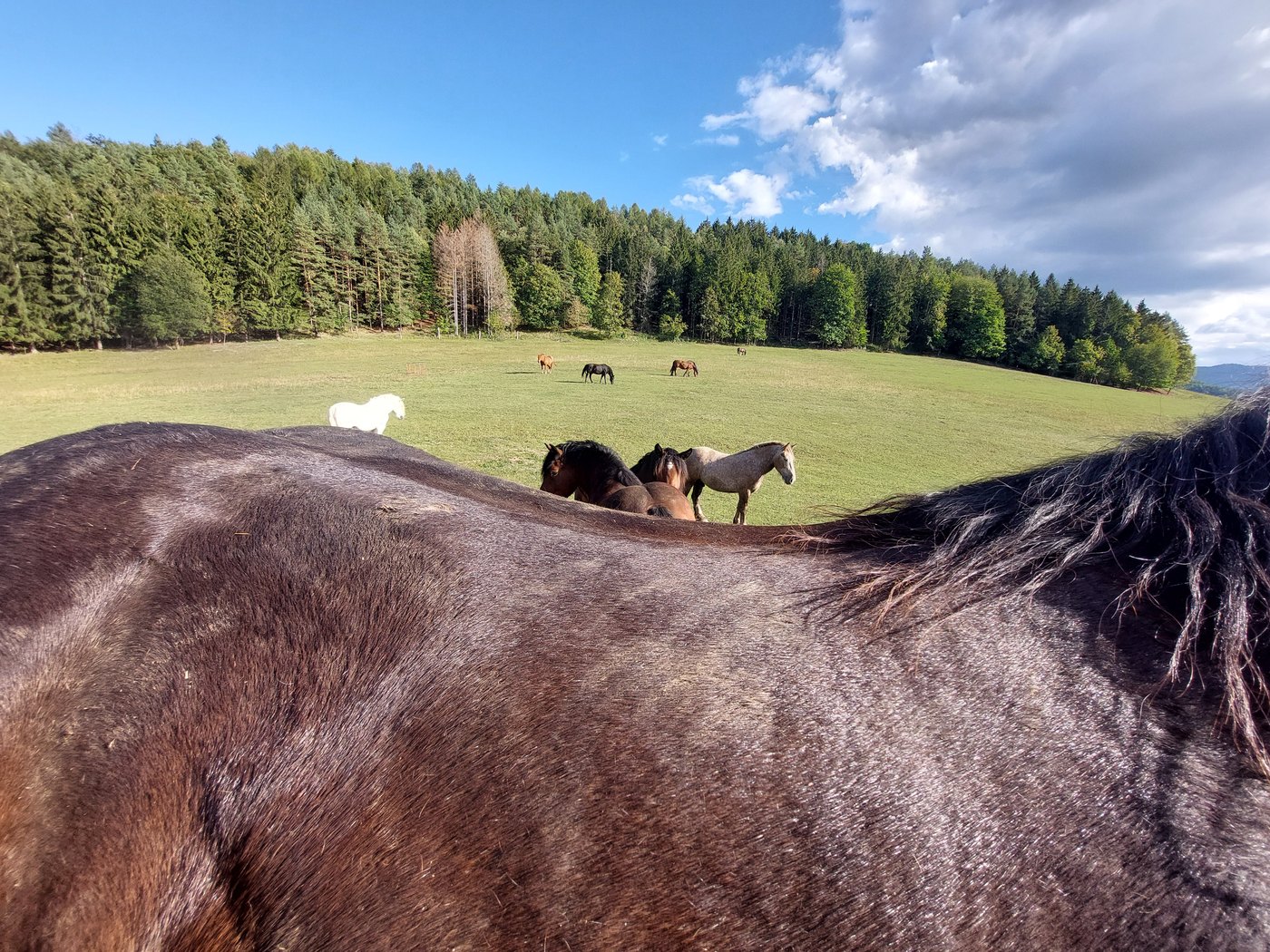
How the geldings protect the herd
We have started taking one of our rescued Alsatians out to the horses with us. The moment the geldings spotted him, three of them lined up side by side at attention and set off to drive him away. Who knows what they would have done to him if they had caught him.
I always call them off, tell them to leave him, that he is ours. But I add the rest straight away: this one is our Zorko, strange dogs you may chase. Just protect the herd, that is the right thing.
For a long time I did not want to take dogs out to the herd at all, and other people's dogs certainly not. At a farm not far from us a dog brought a horse down and injured him so badly that he bled to death. He was alone in a paddock at the time and could not defend himself. On top of that he had spent his whole life at a riding school, he knew dogs and had no idea a dog could be a threat. And he had no herd around him to protect him.
That is why I am not keen on letting even our own dogs near the herd. But it is good to watch the horses slowly getting used to ours, and to see that they can tell a strange dog from ours exactly. A strange dog turned up on the pasture once and the horses ran him off.
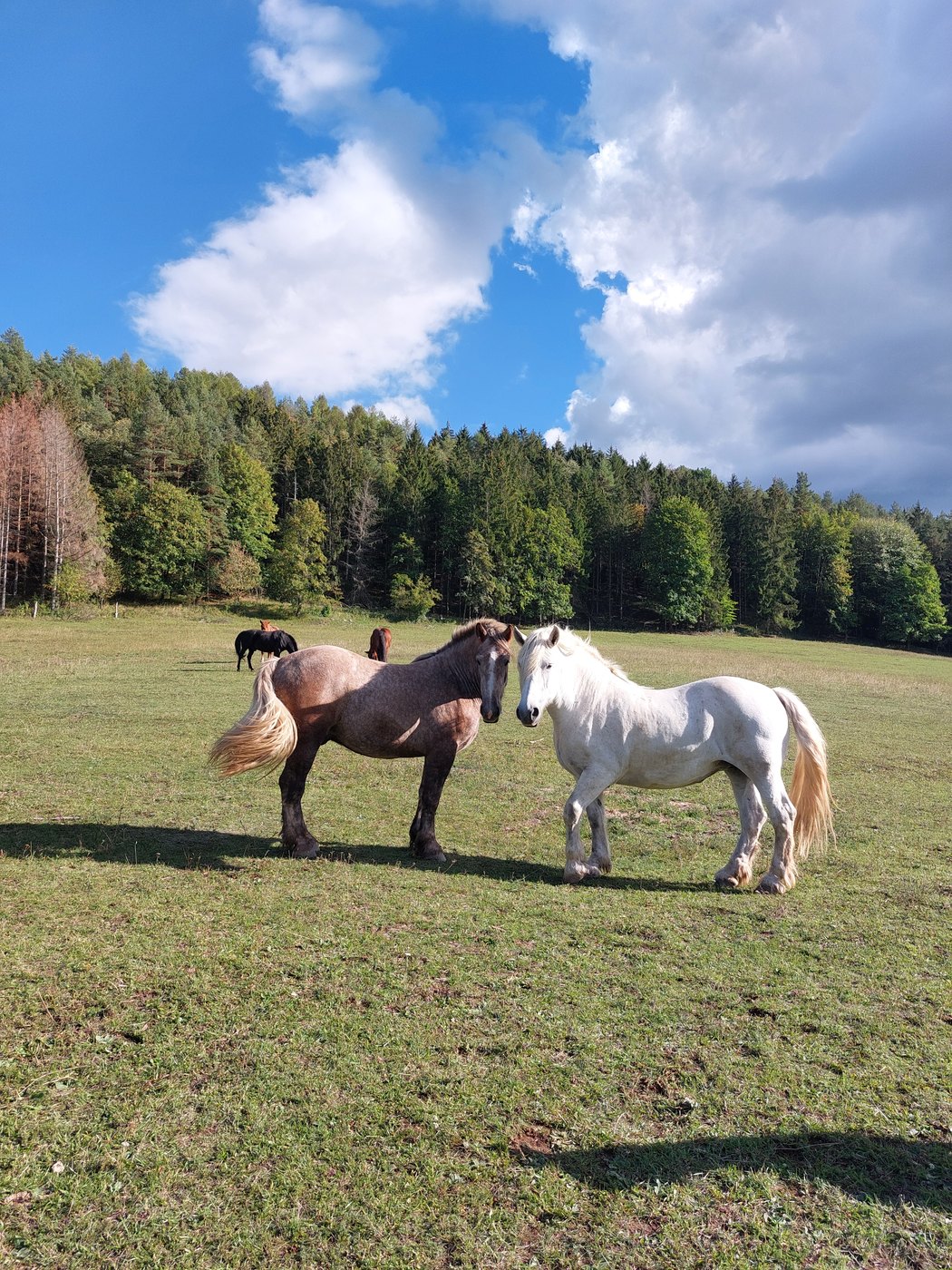
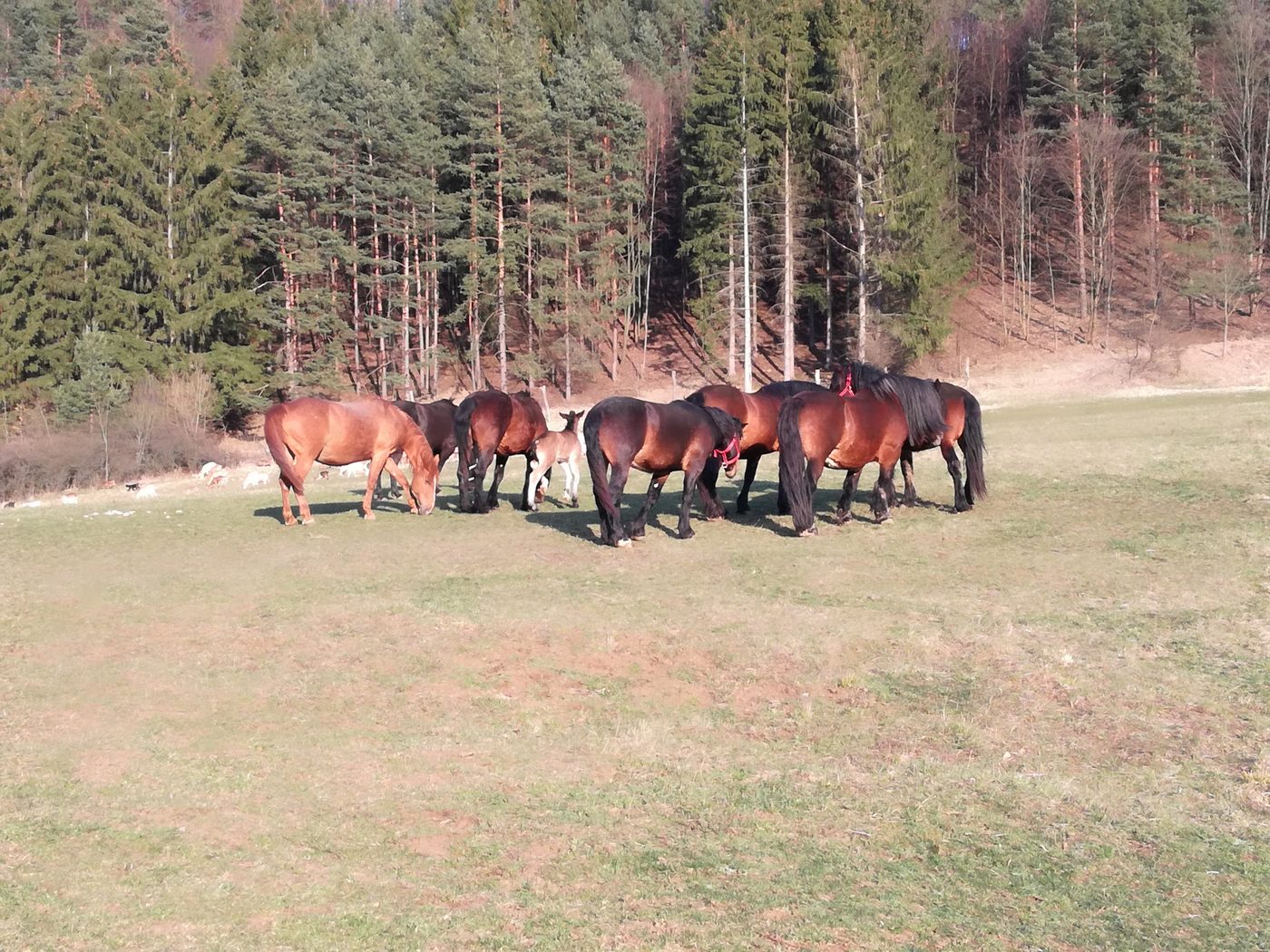
Photo gallery — the herd
Photos of the herd — added as we go.
For those who want to know more. The rest of the page is for anyone interested in how a herd works and why we do it this way.
How a herd works
A herd has an order, and the horses make that order themselves. We don't interfere, we only learn what it looks like.
The queen
The dominant mare. She leads. The herd goes where she goes, and it is around her that it is decided when to graze and when to rest.
The princess
The second mare. She keeps close to the queen, circles around her and guards her and the foals too. It is not a lower role; it is a service.
And there can be several princesses at once, each by her own mare with a foal. Jaška was Lucinka's princess. Maja is Bela's, and she already was during Lucinka's lifetime. Bela had a foal then, Maco, and Maja took her place next to him as soon as she arrived. No one asked her to.
This division into queen and princess is not ours. We once read a beautiful Facebook post about it, and it named exactly what we had until then only watched in the herd without being able to put into words.
We have not yet managed to find the author. If we ever find that post again, we will gladly add it here with the author's name.
The herd has had no queen since August 2025
That is when Lucinka left us. She was the first mare we bought, and she became queen of the whole herd. Since then we have had no queen, and the herd has still not fully reorganised.
We expected it to be a matter of weeks. It wasn't.
Who goes with whom
Within the herd there are smaller groups too. They are not random and they don't change from day to day.
Bela, Maja and Maco
A small group around Bela and her foal Maco, with Maja as princess. They have stuck together for years.
A new horse doesn't go straight into the herd
Horses that come to us have mostly been through treatment, and they only join the herd once they are as healthy as possible. Being accepted by the herd is not always pleasant, and in a day the herd can cover several dozen kilometres of pasture.
We write about it in detail here: We are extending the arrival paddock →
Why we do it this way
A horse is an animal that in nature is never alone. It sees behind itself, hears far away, and all its calm rests on someone else keeping watch while it sleeps.
That is why our horses live outside, on large pastures, together. At night they graze; during the day they go into the shade of the shelters. Not because it is more convenient for us, but because they like it.
Much of what we write here we only learned by watching. Not from books, and not in a week.