o.z. stands for občianske združenie, the Slovak legal form of a non-profit association. Ours is registered with the Ministry of the Interior of the Slovak Republic. It does not exist to make a profit, and the money it receives can only be used for the purposes it was founded for. Our account is transparent, so anyone can see every payment.
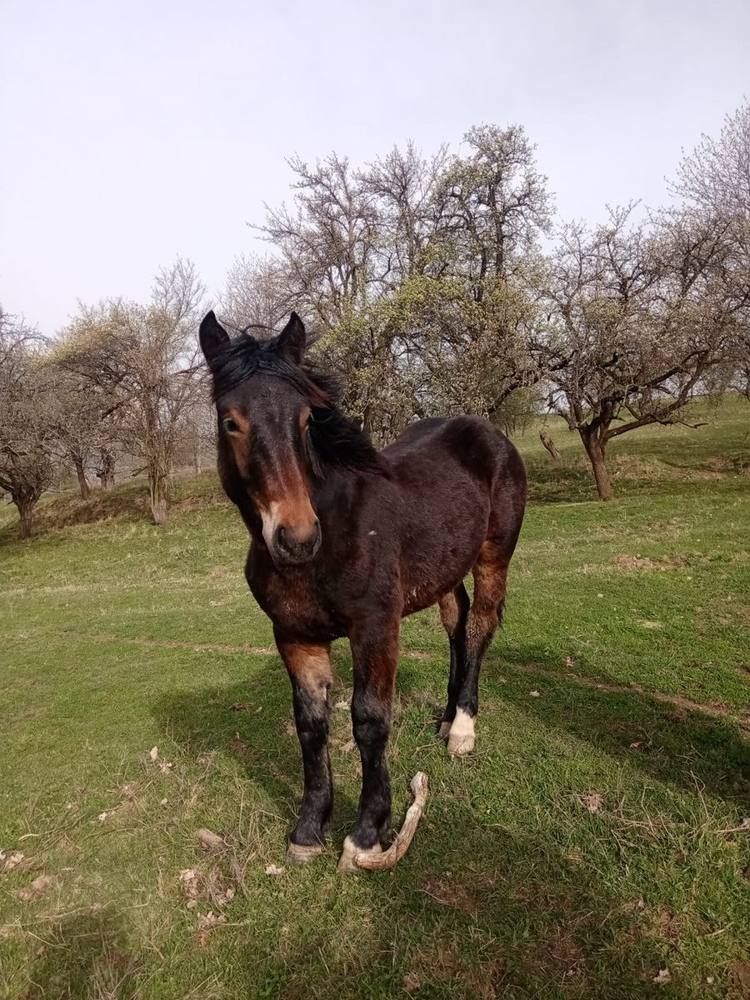
Why “Rio”:Rio was our yearling colt. Fate did not let us save him or help him. The association carries his name, and his short life reminds us why we do all this.
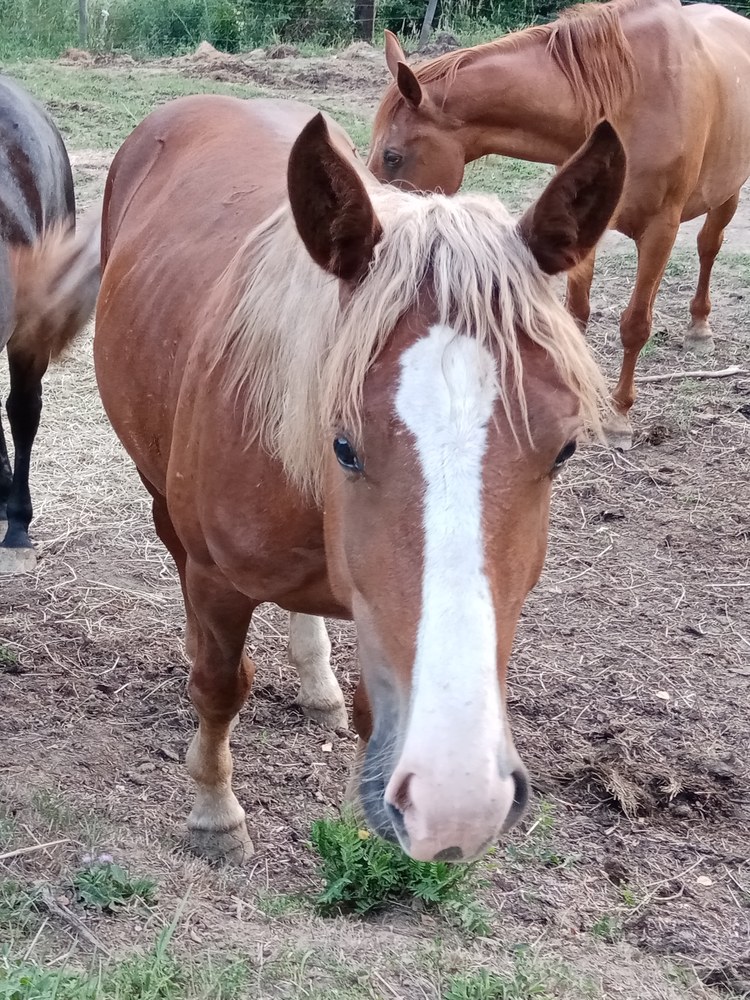
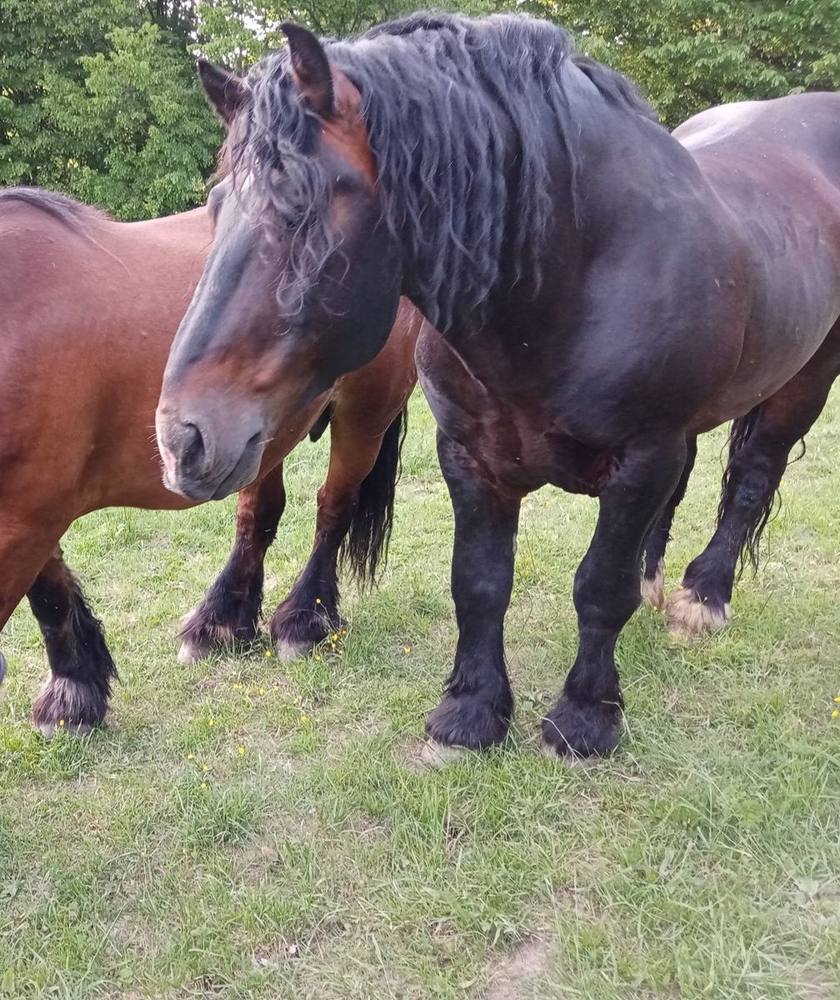
What we do: We are farmers and we have kept draught horses for many years. They live with us in a herd, on pasture, with respect. We write about what our horses have taught us and how they live together. When it is needed and we can manage it, we also take in a horse that needs help. Everything we share is free for anyone to read. Those who want to can help us keep going.
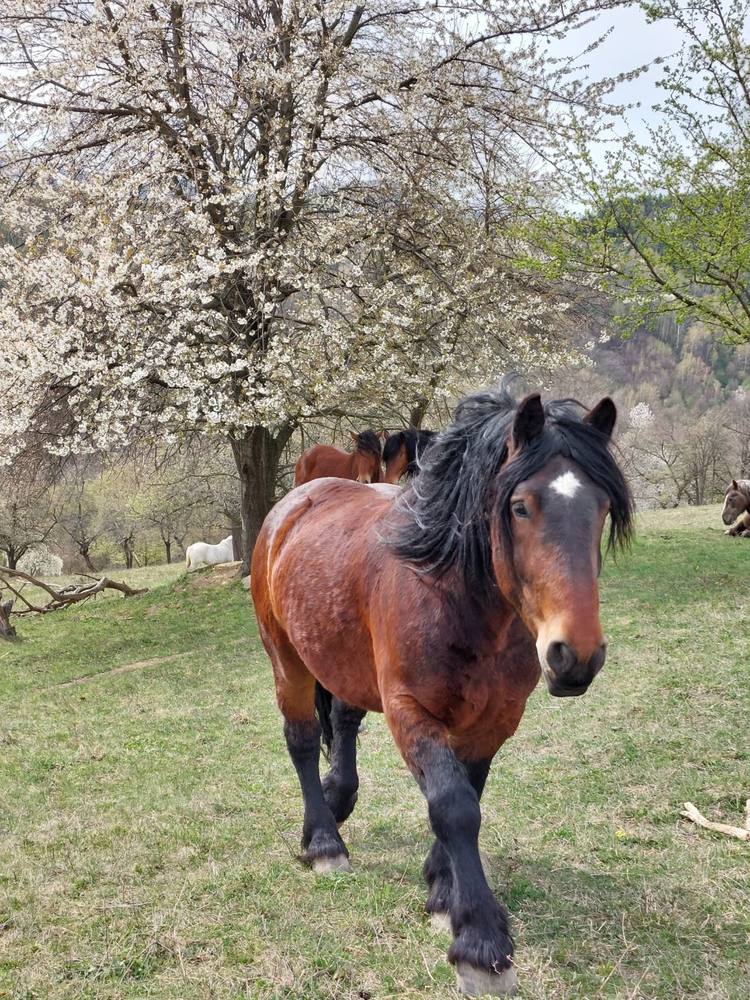
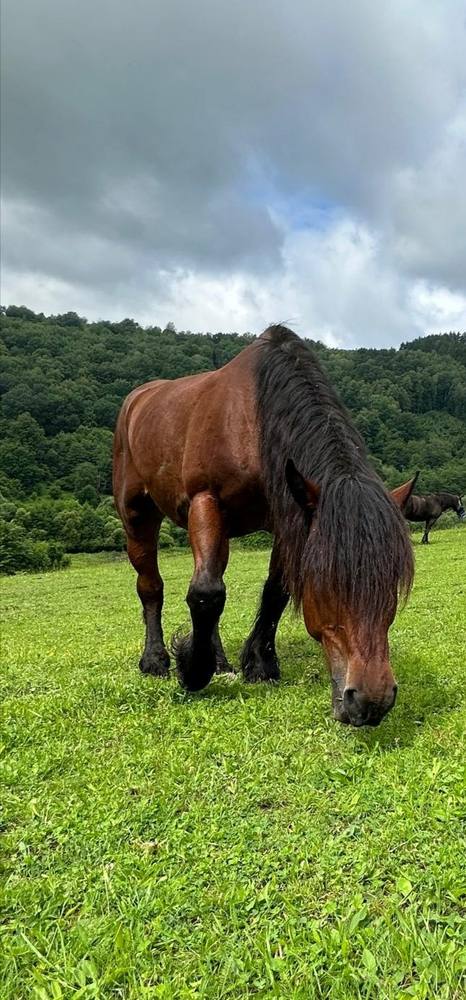
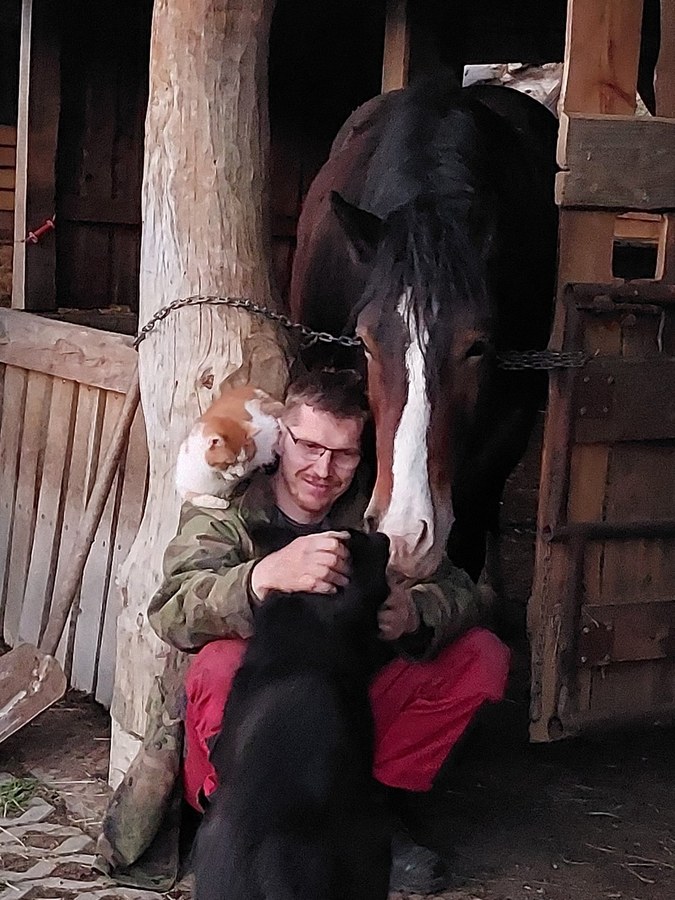
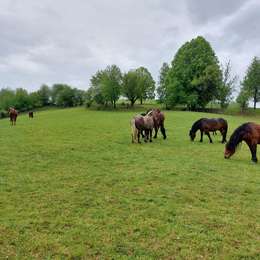
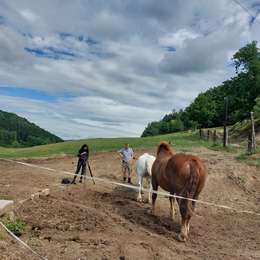
We are Palo and Milka Slávik. We live on a half-wild farm in Slovakia, with horses, cattle and a landscape that has the final say here. Our horses live in a herd, on large pastures, the way horses like it.
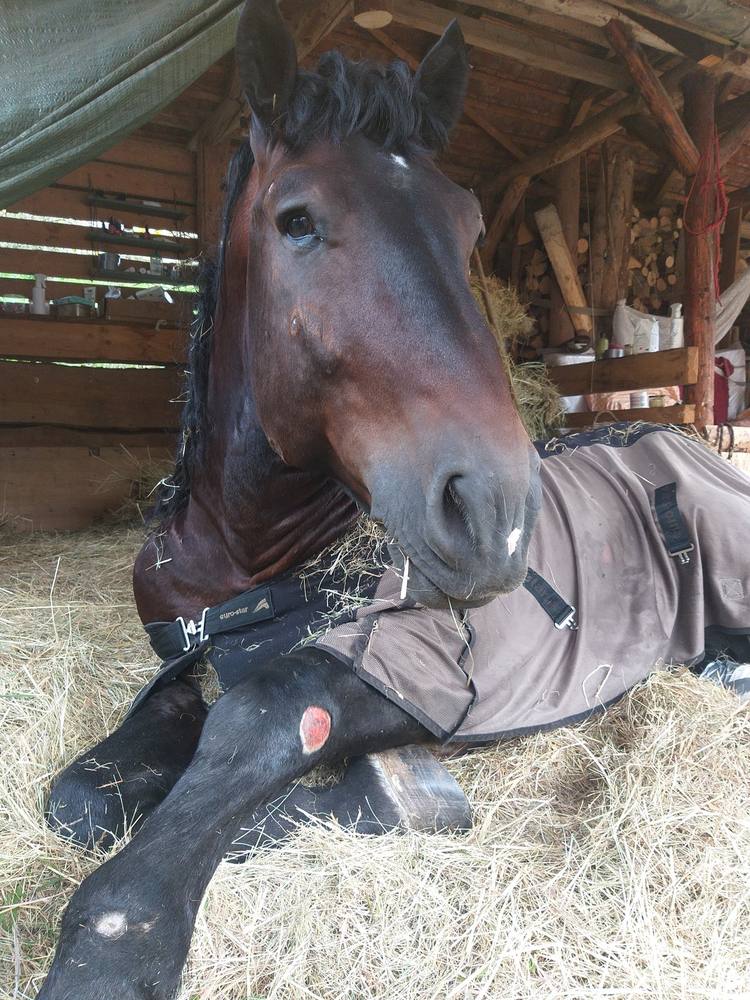
We have kept draught horses for many years. Along the way we have also rescued some of them and been through months of intensive care for injured horses, day and night. That experience is what led us to found a civic association.
When it is needed, we can rescue more horses. But our main mission is a different one: to tell how horses live with us. How we treat them, how they do in the herd and what we have learned from them. We can save a few horses, not all of them. But perhaps someone else will take something from our stories.
RIO o.z. was founded at the end of 2025. It is named after our colt Rio, whose story was short, but the real reason the association exists was Rigo and his long fight for life. Those months of fighting for him convinced us that what we had done with our hearts for years, we should start doing together with you. The association was founded by three people: Palo Slávik, Milka Sláviková and our friend Jarka Rosipalová.
Horses, and in fact the whole species, are the ones who helped us as humankind build modern civilisation. So for us it is not only about helping. It is about a kind of humility and gratitude.
We came to horses almost by chance. We bought a mare so we could check the long fence on the pasture from her back, and we checked it on horseback barely twice. In the meantime we fell in love with horses. And because she came from a horseman who worked with draught horses, through him we found our way among draught horses. We saw how these horses live and work, and that is where we noticed a big difference that is rarely talked about.
A warmblood, a leisure or sport horse, often has a loving owner, is pampered and finds a new home more easily. A draught horse is a worker. It works hard all its life, and when something happens to it, an injury, an illness or old age, it is no longer of use to the horseman.
We are not saying horsemen don't love their horses. But an injured draught horse is a huge problem for them. It is often impossible to find it a home even for leisure riding; for many people it is simply a big horse that eats a lot. And so draught horses end up at the slaughterhouse far more often than others. Young ones too. Even ones that could be healed.
That is why we tell their stories. We want to show that a draught horse, too, can be given a calm life in a herd.
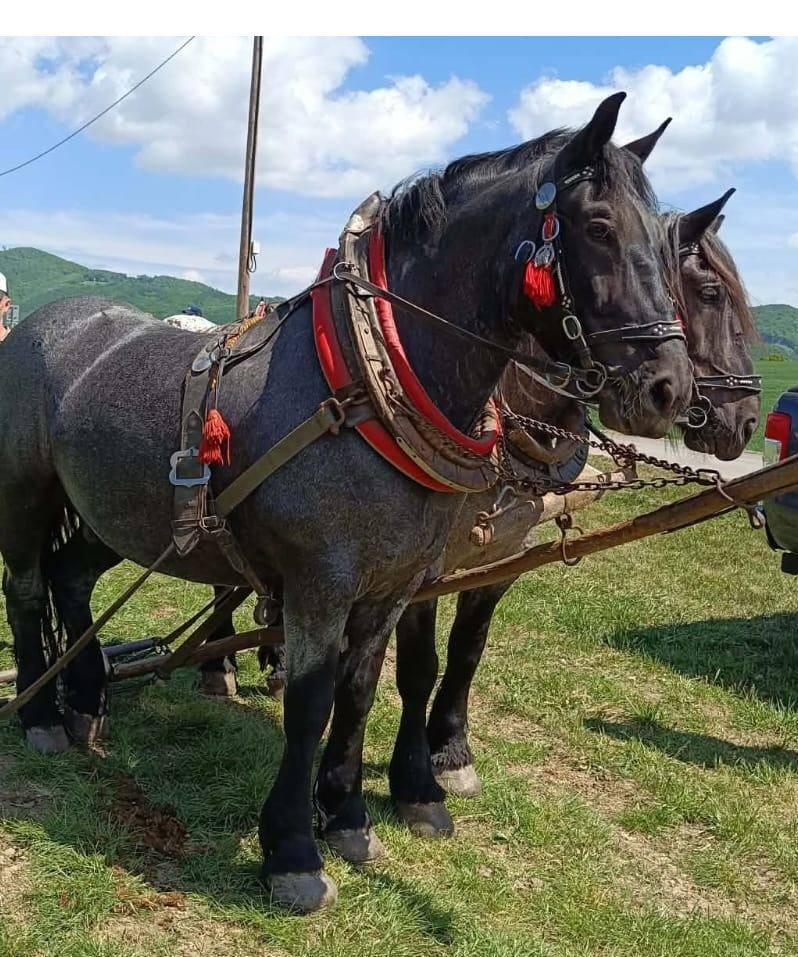
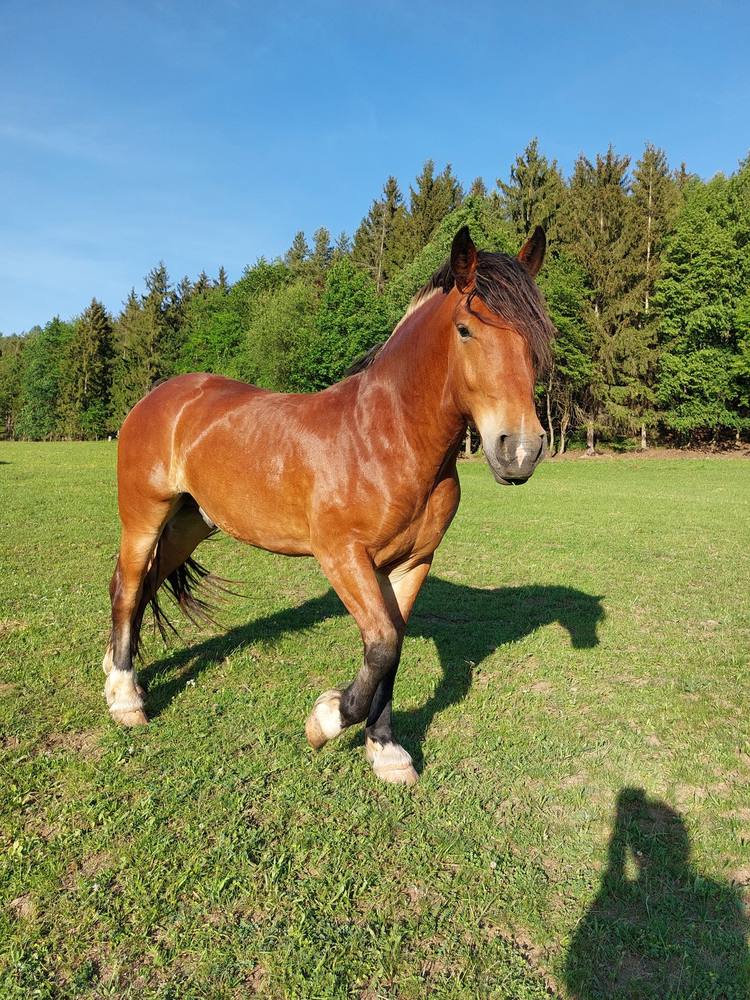
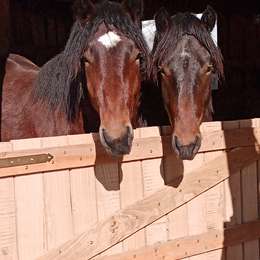
We are breeders and we work only with draught horses. We give horses a home right here with us: a herd and freedom on 65 hectares of pasture, because we have that possibility.
A horse that comes to us stays with us for the rest of its life. We don't pass horses on and we don't look for new owners for them.
A farming background
We are farmers, and our whole association grew out of farmers. Keeping more horses is not such a problem for us as for someone without the conditions for it: we can grow and make our own fodder and don't have to buy it. We have 65 hectares of pasture, so the horses have enormous space to move and graze. It is demanding, but with a farm behind you it can be done.
Our horses are never alone
On a farm you live, you don't just visit. Someone is with the horses several times a day: morning, evening, at night when a mare is foaling or an animal is ill. Besides us, members of the association and people who help us come here, at different times, at weekends and on holidays too. There is always movement on the pastures.
Our pastures are watched by cameras and wildlife cameras, and the footage is recorded.
A herd that heals
Horses that come to us are often in a bad state of mind too. Some were beaten, some had an accident, others only ever worked and never felt any love. They are often broken souls.
But when we let them into the herd among the other horses, it starts to change. They need to be among their own, they need to feel that they are not alone, that they belong somewhere, and we can give them that. Little by little they relax, begin to trust and stop being afraid.
And what is beautiful about it? They give it back to us. The calm that comes when we are among them, when they accept us as part of the herd, when they crowd around us and let us scratch them, is something incredible for us. Quiet and peace in which we forget all our worries. It is like therapy for the soul. They heal us just as we heal them.
“What people have broken, only people can put right.”
Our whole idea of how a horse should live rests on one thing: let him live as naturally as possible. And the most natural thing for a horse is a herd. We may write about the horses one at a time, but that is not how they live — what a horse really is only shows when he is standing among the others.
Who is the queen and who the princess, who goes about with whom and what we have noticed out on the pasture, we write up on a page of its own. These are our observations, not a textbook.
Every animal on our farm has its story. Some are happy, some painful, and all of them taught us something.
Newest arrivals
They came to us most recently, and this is where most is happening.
Steiger
A draught horse who worked in the forest all his life. At work a log struck his hind leg, and his owner, who knew that after years of hard labour Steiger's legs were already weak, decided to give him to our association so he would not end up at the slaughterhouse. Instead, a well-earned retirement in our herd awaits him. We are grateful to his owners for that decision; you can read their story and the collection to support them on his page.
A 21-year-old mare we brought home in July 2026. We heard about her through our vet: lame, in poor condition, shut in a small dark stable, with hooves grown over her shoes, perhaps not reshod for more than eight months. The old man could no longer look after her, but he couldn't bring himself to say goodbye. In the end he decided to give her up. We don't judge him: such things happen and they can be solved. He can come and see Zuza any time. We took her shoes off in the very first days and we are correcting her hooves step by step; you can read about it, with photos, in her story.
Horses that live with us, rescued and born here. Newest first.
Rubín
Rubínko is a Polish cold-blood. He probably injured his leg while working in the forest. His owner treated him, but when it became clear it would take a long time, we took over. We bought him so he would not end up as meat.
The treatment took a whole year. We healed the wound, but it left him with arthritis, and on top of that his front hooves were damaged by neglected shoeing, which we are correcting slowly and with an uncertain outcome. He must not go back to work. With us he is in a well-earned retirement: he has taken over the herd and runs it, with ten draught companions on sixty hectares of pasture.
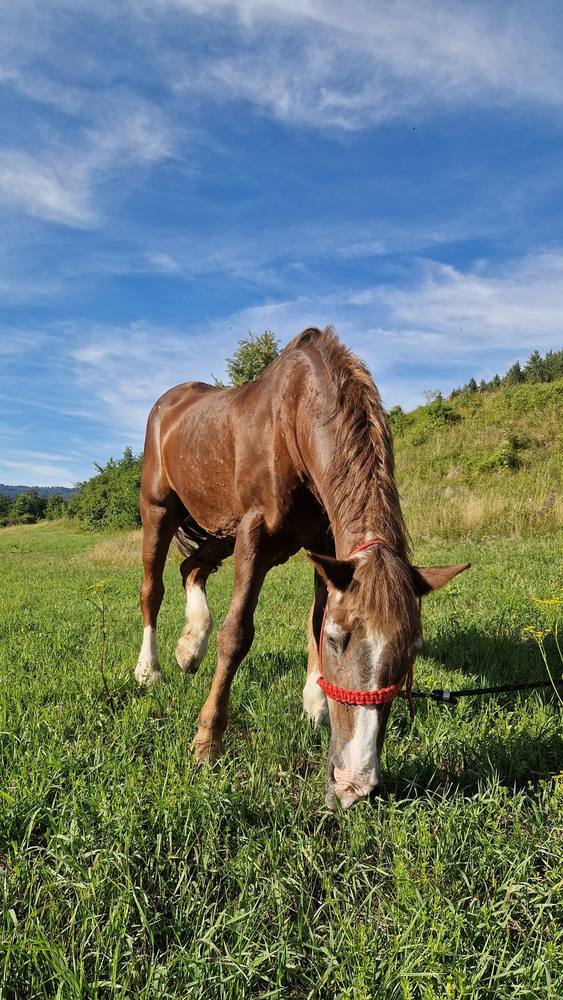
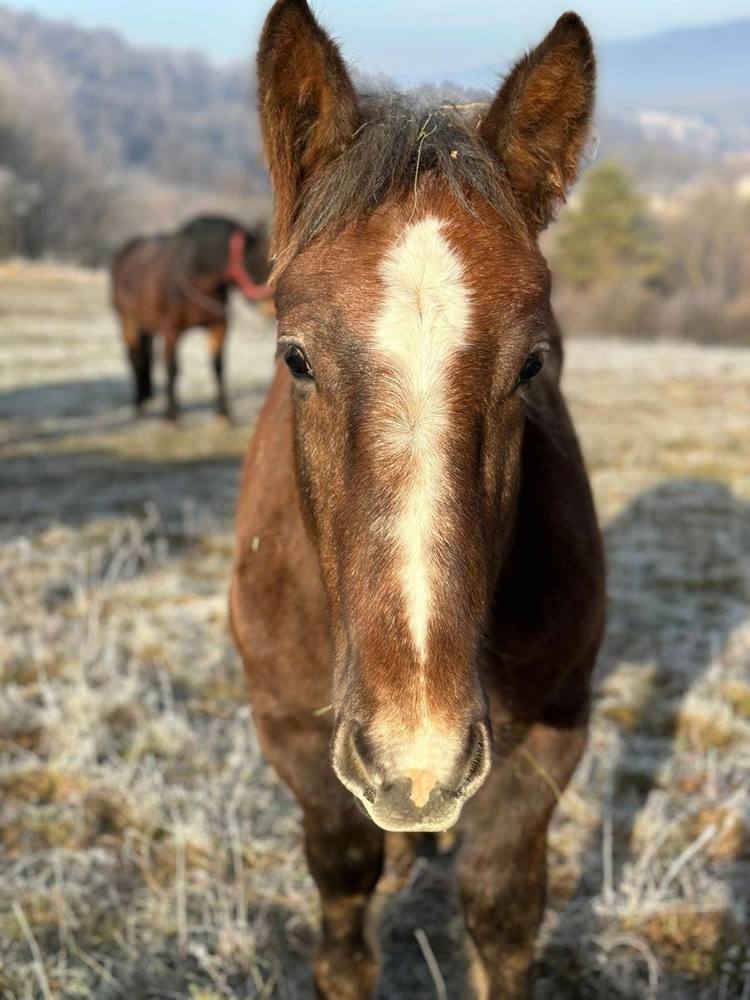
Bela's colt, who at four months survived a serious accident on the electric fence of a neighbouring farm. We treated him for four days, for a month he learned to walk again, and today he is a sturdy gelding whose coat is turning white. He survived what he was not supposed to survive.
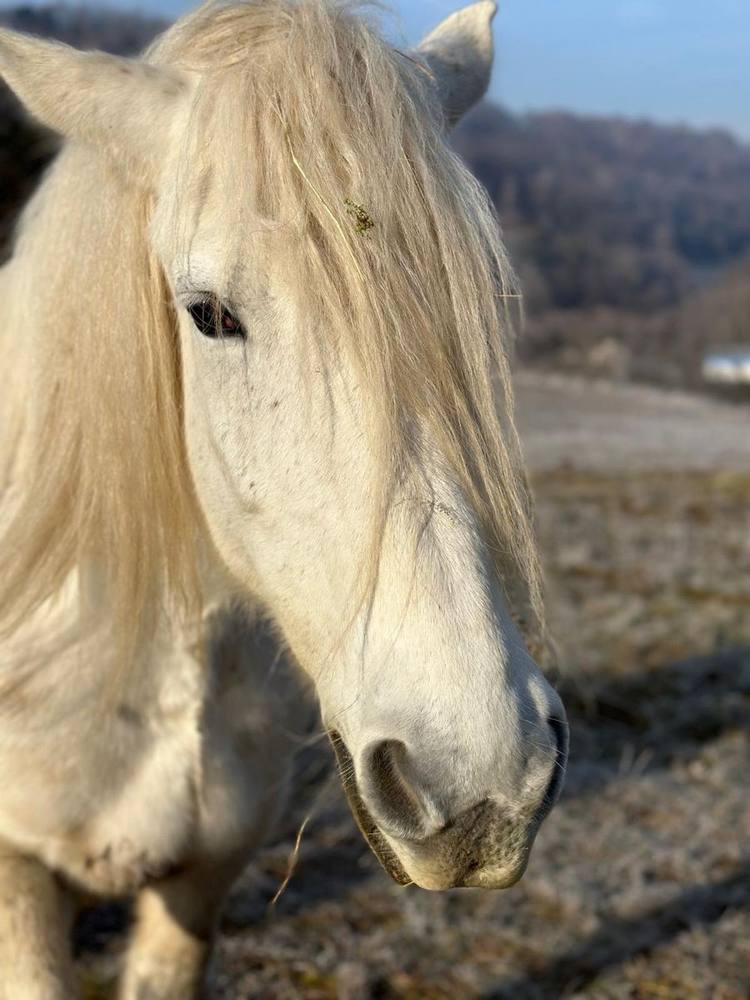
We bought Bela on a whim: we love white draught horses. Only at home, when we were doing her hooves, did we find a split hoof under a single shoe. It was another rescue we hadn't known in advance was a rescue. We are still treating her leg today.
Jarka's horse. He was left over from a riding school that fell apart after its owner died; Milka and I learned to ride on its horses. Today he is retired here with us; he has to be careful with his front legs.
The son of Najka and Buro. He survived the blood-group incompatibility between his parents that took the life of his brother Pačo, but it left him with weakened immunity and a fight against sarcoids that we are still fighting today. Otherwise he is a hefty nine-hundred-kilo gelding with a beautiful big neck.
Lucinka's son and the first foal born here. We too bred horses for sale at first, until we fell in love with them. Balko was the first one where we admitted to ourselves that we would not let him go.
A one-eyed mare of the Muráň Noriker breed. Because of an eye injury she probably suffered at birth, she was taken out of breeding and it was hard to find her a home, so our neighbour Marek bought her and she lives with us. Later her eye was removed, and Jaša became a princess of the herd and the right hand of the lead mare.
Our third horse, and a rescue we didn't know was a rescue at the time. We bought her in the winter of 2020 as a draught mare for breeding. Only at home, when we were taking her shoes off, did we find cracked front hooves underneath, and understood why she was being sold. Today she is the mother of Orík and Pačo.
Horses that don't live with us but are part of our story.
Lysko
He stayed on our pasture together with Buro while their owner temporarily couldn't look after them. I had to give him back, and I still regret it. He stayed in my heart, and I always think how much better his life would be in a herd.
Buro lived in our herd while his owner temporarily couldn't look after him, and for at least a month he enjoyed freedom outside the stable, among his own kind. Then we had to give him back. In August 2026 his owner found him a new home with people where Buro used to go to cover mares: paddocks, pastures and mares around him. He will have a good retirement.
The ones we lost. We have left their stories whole.
Rigo
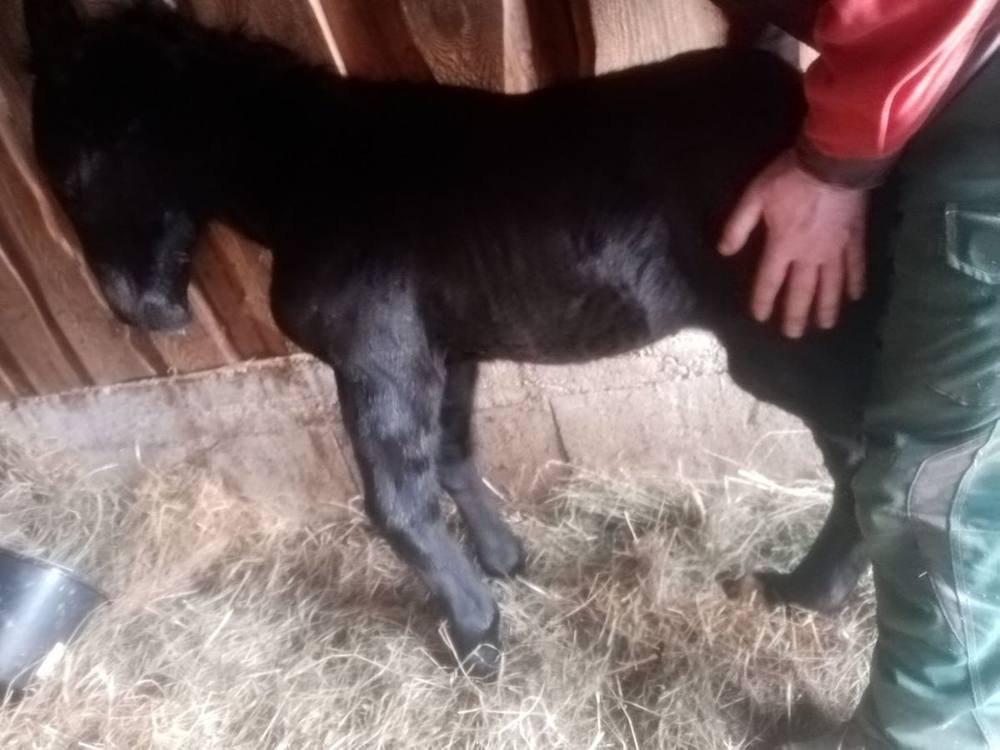
A draught horse of the Muráň Noriker breed. In August 2025 he came to us with Monday morning disease. A young, strong horse who could not get up. Eight months of fighting for his life followed: days and nights at his side, drips, a lifting sling, laser and other treatments we tried together with the vets. He fought bravely until April 2026. We could not save him, but no one has taught us as much as he did. Thanks to Rigo, too, we can help other horses better today.
Our first horse and the lead mare of the herd: when Luca gave an order, everyone obeyed. She left us in August 2025 on her own, at sunset, surrounded by her herd, in a place she loved. Without a single wound, without a struggle, as if she wanted to make the days easier for us while we were fighting for Rigo.
The colt of Najka and Buro, who lived only two or three days. From the start he didn't like his mother's milk, and only the post-mortem showed why: his parents' blood groups were incompatible and Najka's immunity killed him through her milk. His short story taught us a big lesson, and it is exactly why we share what we learn.
It's easy to say “we help horses”. This is what it means in reality.
Rubín was headed for slaughter with an injured leg. A year of treatment, and today he runs the herd. His story →
Najka was a mare about whom, as she was being loaded, someone said it would be a shame to send her for meat. This is her sixth year with us. Her story →
Zuza stood for a year shut in a dark stable with hooves grown over her shoes. Today she goes out to the grass with Steiger. Her story →
Steiger was supposed to end up at the slaughterhouse after an injury. His owner gave him to us instead. His story →
Not everything ends like this. Rigo, Rio, Pačo and Lucinka are among the stories above, and we don't leave their stories out. But this is why it is worth trying.
What they can teach us
We also write about what we have found out with horses, sometimes the hard way. Perhaps it will save someone else the trouble. These are our experiences, not a textbook.
On Rigo's we write about Monday morning disease, which can be prevented: when a horse has stood in the stable for several days, the feed should be cut back rather than left the same, and after such a rest it should not go straight back into heavy work. His story →
Pačo taught us that a blood-group incompatibility between the parents can kill a foal, and that it can be prevented. His story →
On Zuza's page, we show why hooves neglected for years are not corrected all at once, but millimetre by millimetre. Her story →
A new horse doesn't go straight into the herd here. First it gets to know the others across a fence. How we do it →
The herd is the most natural thing for a horse. We write down what we notice in it as we go. How they live together →
Our vet
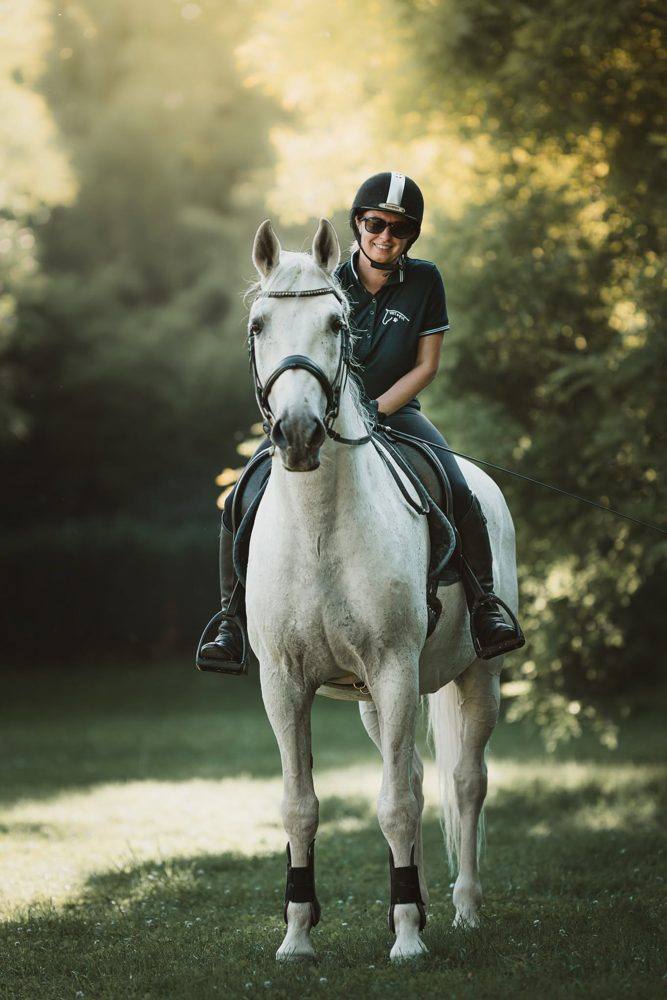
We are lucky to have a vet who has been with us from the start: at rescues, at night-time call-outs and at decisions that are not easy. Without her many of our stories would have ended differently.
All my life I relied on my own hands. Whatever was needed, I earned. When something didn't work, I found a way. I never asked anyone for anything, and it never even occurred to me.
Then the horses came. First one, then another. And with them work that is more than two hands can do: the vet, hay for the winter, hooves, medicine, diesel for the tractor. You can't pay for that with skill. It costs money that a farm simply doesn't have.
The money you send us never reaches me. It goes on feed, the vet and materials. The work, the land, the machines and the time we give ourselves, and we don't bill anyone for them.
Whoever donates to us isn't buying anything. But they get something for it: a result. Zuza stood for a year in a dark stable with hooves grown over her shoes. Today we lead her out to the meadow to graze and we are putting her hooves right step by step. With your money too.
That is why the horses' stories here are more detailed than usual, with dates and before-and-after photos. They are not pleas. They are an account. And our account is transparent, so you can check every payment yourself.
And one more thing, to be clear. We only collect directly for horses that need treatment or ongoing care : Steiger, Zuza, Orík, Bela and Rubín. We don't collect for our healthy horses. We can take care of them ourselves, and asking for money for our own animals when nothing is wrong with them doesn't feel right to us.
Whoever wants to help them too can support the work of the association. From that we pay for the treatment of horses that need it right now and hay for the whole herd, so part of it always reaches the horses we have already healed. That is help too: keeping what once succeeded.
You can also help without money. With materials lying around unused. With your hands when hay needs making. And by telling others about us.
Asking for help with something I don't do for myself is something I had to learn. I am still learning.
— Palo
How to help
What we show and tell here is free for everyone. Whoever wants us to be able to carry on, and wants the horses to do well here, can support us. Some help with their hands and time, others with materials. Money is only one of the ways.
Donation
Send a donation to our transparent account at Fio banka. Every euro goes on feed, veterinary care and materials.
Slovak taxpayers can assign us 2% of their income tax. We are preparing our registration as a recipient and will add the details here as soon as we have it.
Virtual adoption
Adopt from afar a horse that is being treated right now and contribute directly to its care. We don't collect for our healthy horses; with them you will find a link to support the work of the association. You can choose a horse in the section Stories; the bank details are on its page.
Membership
Become a member of the association and be part of it for good. Application →
Volunteering
Work on the farm, help with the animals, a pair of hands. Get in touch.
Material help
Hay, feed, veterinary supplies, tools. We will agree on what is needed right now.
Donate now
From abroad, a SEPA transfer works from any bank in the EU. If you want to support a particular horse, write its name in the payment reference, or choose it in the section Stories, where each horse has its own bank details.
Our account is transparent. At any time you can publicly see what came in and what we spent it on: account statement at Fio banka.
Bank transfer (SEPA)
Account holder: RIO o.z. IBAN: SK97 8330 0000 0027 0350 7560 BIC/SWIFT: FIOZSKBAXXX Payment reference: RIO
Our account is transparent, every payment is public here. Before you confirm, please check that the recipient is RIO o.z. and the IBAN ends in 7560.
What we need right now
It isn't money: these are specific things we need right now and that may be lying around unused somewhere.
Aluminium shovel
Light, for mucking out. Ours is wearing out and we have it in our hands in the stable every day.
Corrugated pipe
1 metre in diameter, 6 metres long. It will become a water reservoir: the drought taught us that relying on rain is not enough.
LDPE hose, 50 mm and 32 mm
About a kilometre of each. It will carry water from the reservoir across the pastures to the drinking troughs. We can do the digging and the installation ourselves.
Concrete utility poles
Decommissioned concrete poles left over from power line renovations. For us they are ideal load-bearing parts for building an open-sided stable into the hillside.
We no longer need concrete panels for the troughs : the local agricultural cooperative donated them. Thank you.
This association doesn't rest on the three of us alone. It rests on people who come when needed and ask nothing for it.
Martin
He comes to drive the tractor for us and to make hay. Without him our work would be much harder, and whether the herd gets through the winter depends on the hay season.
Vojo
A young farmer and tractor driver. He comes, gets into the tractor and works, without fuss and without needing to be asked twice.
Family
Thank you to our family for being with us.
Aďa and Šimon
Our students. They have little time, but when they can, they are glad to come and get stuck in.
Miro and Maja
And everyone around them. Whenever hands are needed, they are with us, and they never ask what's in it for them.
The local agricultural cooperative
It donated concrete panels for our drinking troughs, something we had carried on our list of needs for a long time. And beyond that, we share years of good neighbourly relations, where we help each other when needed.
And a thank you of a different kind belongs here too, to the one who stands by us as a professional.
Our vet. Her work is a craft and we pay her for it as we should, but many times she has helped us beyond that, for free and at times when no one else would.
We take in horses according to how many we can really manage, not how many we would like to. We decide on each one together with our vet, and always only once we know what the horse needs and whether we can pay for it.
We give every case that reaches us proper attention. And when we say no, it only means we have no room, not that we don't care about that horse.